Srae Pas Ssa_121025_clean
SRAE PAS SSA_121025_CLEAN.docx
Sexual Risk Avoidance Education (SRAE) Performance Measures
OMB: 0970-0536
Alternative Supporting Statement for Information Collections Designed for
Research, Public Health Surveillance, and Program Evaluation Purposes
Sexual Risk Avoidance Education (SRAE) Performance Measures
OMB Information Collection Request
0970-0536
Supporting Statement
Part A
Type of Request: Revision
December 2025
Submitted By:
Office of Planning, Research, and Evaluation
Administration for Children and Families
U.S. Department of Health and Human Services
4th Floor, Mary E. Switzer Building
330 C Street, SW
Washington, D.C. 20201
Project Officers:
Caryn Blitz, Selma Caal
Part A
Executive Summary
Type of Request: This Information Collection Request (ICR) is for approval of a temporary extension of currently approved information collection activities and revisions to be implemented in 2026 for the Sexual Risk Avoidance Education Performance Analysis Study (SRAE PAS). We are renaming the ICR to Sexual Risk Avoidance Education (SRAE) Performance Measures. We are requesting three years of clearance.
Description of Request: The goal of the SRAE performance measures is to collect performance measures data from SRAE grant recipients on program structure, cost, and support for implementation, including how programs addressed the A–F topics; 1 attendance, reach, and dosage; and program participants’ characteristics, sexual and other risk behaviors prior to program participation, and outcomes at program exit. The performance measures have and will continue to allow both the Administration for Children and Families (ACF) program office and grant recipients to monitor and report on progress in implementing SRAE programs and informs technical assistance. The data collected in the study are not intended to be generalized to a broader population. We do not intend for this information to be used as the principal basis for public policy decisions.
Progress to Date: OMB originally approved the information collection in October 2019, and grant recipients have been collecting SRAE performance measures data since January 2020. One-year extensions were granted from OMB in January 2024 and December 2024. In the most recently completed reporting year (2023-2024), performance measures data were submitted for 190 grants and 490 program providers, including entry survey data for 187,482 youth participants and exit survey data for 148,203 participants.
Timeline and Time Sensitivities: There were no challenges to meeting the original timeline. SRAE grant recipients have been collecting and submitting performance measures data on an ongoing basis since January 2020. The current OMB expiration date is December 31, 2025. ACF is requesting a temporary extension of the currently approved instruments, through June 2026, followed by proposed revisions to be implemented in July 2026 to allow grant recipients to continue collecting and submitting data as they provide programming to additional cohorts of youth.
During those six months grant recipients will also have adequate time to obtain institutional review board and any other local approvals needed to begin using the revised entry and exit surveys in July 2026.
Previous Terms of Clearance: The Notice of Action (NOA) received on January 9, 2024, stated that the request was “approved for 1-year consistent with the understanding that ACF will submit changes to include replacement of its binary sex question across instruments for a more inclusive gender base question(s) upon completion of agency testing and discussions.” ACF had begun pretesting potential replacement questions but ended this effort in alignment with Executive Order 14168.
Summary of changes requested: ACF is requesting approval for a temporary extension of the existing performance measures (through June 2026), followed by transition to revised measures (from July 2026 onward). The revised measures are designed to (1) address feedback from grant recipients to simplify and clarify participant surveys, (2) align race and ethnicity measures with current OMB guidance, and (3) ensure the measures meet FYSB data needs by removing items related to COVID-19 and others not widely utilized and replacing them with other measures of interest. The proposed changes shorten the data collection instruments and will reduce respondent burden. We expect a 61 percent reduction in the annual burden hours under this request compared to the previously approved annual burden. Current and revised versions of Instruments 1 through 4 are included in this submission.
A1. Necessity for Collection
The consequences of adolescent sexual activity remain a critical social and economic issue in the United States, shaping the lives of thousands of teens and their families every year. Despite declining births to teen mothers over the past 25 years, the teen birthrate in the United States remains higher than in other industrialized countries and varies widely across geographic regions and racial/ethnic groups (Martin et al., 2017). In addition, almost half (48 percent) of reported cases of chlamydia, gonorrhea, and syphilis were among adolescents and young adults (Centers for Disease Control and Prevention, 2023). Sexual activity in youth is also related to engaging in other risk behaviors, such as alcohol and substance use.
The Sexual Risk Avoidance Education (SRAE) Program targets these issues. SRAE is funded generally under the authority of Title V, Section 510 of the Social Security Act, 42 U.S.C. § 710(b)(6) and specifically by the appropriation for General Departmental Management for the Office of the Secretary under Division H, Title II of the Consolidated Appropriations Act, 2016, Pub. L. 114-113. As updated by Congress in FY2018, the legislation enables grant recipients to “implement education exclusively on sexual risk avoidance (meaning voluntarily refraining from nonmarital sexual activity)” and permits including medically accurate information on contraception that ensures program participants understand that contraception offers physical risk reduction and not risk elimination. The legislation also includes A–F criteria to ensure youth receive a variety of information to improve their future health and well-being.
With this information collection extension request, the Family and Youth Services Bureau (FYSB) and Office of Planning, Research, and Evaluation (OPRE) in the Administration for Children and Families (ACF) at the Department of Health and Human Services (HHS) seek approval to continue collecting performance measures (PM) data from SRAE grant recipients, program providers, and youth participants. The collection and analysis of PM plays a unique role in the mix of current federal evaluation efforts to expand the evidence base on teen pregnancy prevention programs. The SRAE PM is the only federal effort to collect PM data on sexual risk avoidance programs. This information collection will allow both the program office and grant recipients to continue to monitor and report on progress in implementing SRAE programs.
The Government Performance and Results Act (GPRA) Modernization Act of 2010 (Public Law 111-352) requires federal agencies to report annually on measures of program performance. It is essential that SRAE grant recipients submit the PM data described in this ICR to enable ACF to carry out its reporting requirements to the Office of Management and Budget (OMB). Further, collecting these data will allow grant recipients and ACF to report to other key stakeholders on SRAE program design, implementation, and outcomes.
A2. Purpose
Purpose and Use
The objective of the SRAE PM effort is to document how SRAE-funded programs are operationalized in the field and assess program outcomes. The PM data will continue to be used by the program office and SRAE grant recipients to monitor and report on implementation progress and inform continuous quality improvement of SRAE programs. The data provide ACF with up-to-date information on youth participant characteristics, service receipt, and outcomes, and on program infrastructure, reach and scope, and program content. ACF uses the information to (1) assess whether SRAE objectives are being met (e.g., in terms of the populations served); (2) provide technical assistance to help drive programs toward continuous improvement of service delivery; and (3) fulfill reporting requirements to OMB concerning the SRAE initiative. ACF also shares grant recipient- and subrecipient-level findings with each grant recipient to inform their own program improvement efforts. In addition, ACF data are and will be used in public-facing reports and fact sheets targeted to broader audiences, including practitioners.
The information collected is meant to contribute to the body of knowledge on ACF programs. It is not intended to be used as the principal basis for a decision by a federal decision-maker and is not expected to meet the threshold of influential or highly influential scientific information.
Research Questions
The PM will continue to provide insight into questions related to program and participant characteristics, program inputs and outputs, and participant outcomes. Key questions include the following:
Questions related to grant recipients’ management of their grant(s):
How many grant recipients awarded sub-awards to subrecipient program providers to implement programming?
How do grant recipients support program providers’ implementation of SRAE programs?
How did grant recipients allocate their SRAE budgets?
Questions related to program providers’ delivery of their program(s):
What proportion of program providers provided services through schools, versus community-based settings, versus other settings?
What proportion of program providers addressed each of the A–F topics?
Questions related to program instructors:
How many facilitators and educators are employed in providing SRAE programming?
What proportion of program instructors received training in the programs they implemented?
To what extent are program instructors monitored to ensure program quality?
Questions related to program participants:
How many youth were served by SRAE programs?
What were the characteristics (e.g., demographics) of the youth served?
At program exit, what influences did youth participants perceive the program had on their knowledge, attitudes, and behavioral intentions related to the topics covered in SRAE programs? For example, what percentage of youth participants reported at program exit that participating in SRAE made them more likely to intend to delay having sex?
What trends in participant outcomes can be identified over time? For example, for each successive year of the SRAE Program, how do outcomes related to knowledge, attitudes, and behaviors compare to previous years’ outcomes?
A major objective of the PM analysis is to construct, for grant recipients and ACF, a picture of SRAE implementation in the form of a basic set of statistics across all grants. These statistics, for example, will continue to answer questions for the overall SRAE programs, such as the following:
What programs were implemented, and for how many youth?
What are the characteristics of the populations served?
To what extent were members of vulnerable populations served?
How many youth participated in most program sessions or activities?
How many entities are involved at the subrecipient level in delivering programs?
How do grant recipients allocate their resources?
How do participants feel about the program, and how do they perceive its effect on them?
What challenges do providers experience in implementing SRAE programs?
Study Design
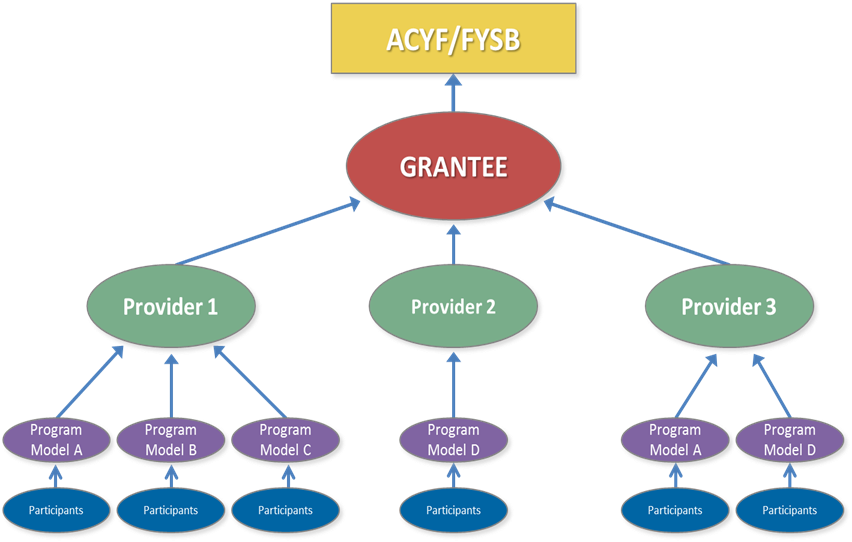
Collecting PM data from SRAE grant recipients, program providers, and participants allows both the program office and grant recipients to continue to monitor and report on progress in implementing SRAE programs. The study design reflects the multiple layers that grant recipients use to support program delivery. For example, some grant recipients directly implement the programs, and others deliver programs through subrecipient providers. The data that the grant recipients submit to ACF will continue to originate from three levels of respondents: the grant recipient, program provider(s), and youth participants (Figure A2.1). For some PM, grant recipients will continue to provide data about activities or decisions that they undertake directly at the grant level. For other measures, data will continue to come from the program providers to the grant recipient because providers are the ones implementing the activities to be documented. In addition, some data will continue to come from the youth themselves via entry and exit surveys. As in past years, the grant recipients will be responsible for ensuring that all PM are submitted to ACF.
Figure A2.1. Levels of Performance Measures Data
This information collection involves collecting PM data using previously-approved instruments with proposed revisions to continue the ongoing information collection for SRAE PM:
Instrument 1: Participant entry survey
Instrument 2: Participant exit survey
Instrument 3: Performance Reporting System Data Entry Form
Instrument 4: Subrecipient Data Collection and Reporting Form
The participant entry and exit surveys (Instruments 1 and 2) will continue to collect youth self-report data on youth demographics and special population status (e.g., foster care, homelessness, adjudicated, etc.). The participant entry survey also collects information on participants’ prior sexual behaviors and other behaviors, knowledge, and attitudes related to the A–F topics. The participant exit survey also collects information on participants’ perceptions that their participation in the program had an influence on their sexual and other behavior intentions (e.g., intentions to avoid sex) and on their knowledge and attitudes relating to other A–F topics. There are four versions of the entry survey (Instrument 1) and two versions of the exit survey (Instrument 2) for both the current and revised instruments, listed below.
Instrument 1a: Entry survey for high school and older youth
Instrument 1b: Entry survey for middle school youth
Instrument 1c: Entry survey for high school and older youth in programs with impact evaluations
Instrument 1d: Entry survey for middle school youth in programs with impact evaluations
Instrument 2a: Exit survey for high school and older youth
Instrument 2b: Exit survey for middle school youth
The versions for middle school youth exclude some of the more sensitive items. The entry survey versions for programs with impact evaluations include only a limited number of questions, to decrease burden due to grant recipients’ participation in other studies that often include extensive surveys. Programs with impact evaluations use the same version of the exit surveys as other programs.2
The program-level data collection forms (Instruments 3 and 4) will continue to be used by grant recipients and subrecipient program providers to submit their data on SRAE program structure and delivery:
SRAE program structure refers to how grant funds are being used; the program models selected; their coverage of the required A–F topics; and the ways in which grant recipients and subrecipients support program implementation; and challenges experienced in implementing the programs. This information will continue to be collected from the grant recipients (Instrument 3) and their subrecipient program providers (Instrument 4). Subrecipients submit their data on these topics to grant recipients, who then compile this information and submit it to ACF once a year (Instrument 3).
SRAE program delivery refers to the extent to which the intended program dosage is delivered, youths’ attendance, including the characteristics of the youth served, reach, and dosage. This information will continue to be collected from program providers (Instrument 4) and submitted to ACF by the grant recipients twice a year (Instrument 3).
The PM data will continue to be submitted by grant recipients to the SRAE Performance Measures Data Portal, which the contractors developed and maintain. The frequency with which performance data are collected and submitted by grant recipients is summarized in Table A2.1.
Table A2.1. Collection Frequency for Performance Measures Data
Data Collection Instrument/Content |
Respondent |
Frequency of Collectiona |
Frequency of Submission to ACF |
#1 Participant Entry Survey |
Youth participants |
|
|
Demographics; sexual and other risk behaviors; pregnancy history |
At program entry |
Twice a year |
|
#2 Participant Exit Survey |
Youth participants |
|
|
Demographics; participant perceptions of program effects on sexual intentions and other behaviors; participant assessments of program experiences |
At program exit |
Twice a year |
|
#3 Grant Recipient Performance Reporting Data Entry Form |
SRAE grant recipients |
|
|
Total respondent counts by measures of attendance, reach, and dosage; hours of programming delivered
Administrative data on measures of structure, cost, and support for program implementation |
At cohort completion
Once a year |
Twice a year
Once a year |
|
#4 Subrecipient Data Collection and Reporting Form |
Subrecipient program providers |
|
|
Respondent counts by measures of attendance, reach, and dosage; program completion by cohort
Administrative data on measures of structure, cost, and support for program implementation (including program characteristics; staffing training and observation; and implementation challenges and technical assistance needs) |
At cohort completion
Once a year |
Twice a year
Once a year |
a “Collection frequency” refers to when grant recipients, their subrecipients, and program staff collect the data that are later compiled and submitted to ACF. Grant recipients submit the data twice a year to ACF in order to inform continuous quality improvement.
The SRAE PM are designed to describe the implementation and outcomes of the SRAE Program. The PM data will continue to provide necessary information to ACF to effectively manage and report on the program and for grant recipients to use for continuous quality improvement.
The PM data cover the entire universe of SRAE grant recipients, programs, and participants, but are not designed to be representative of or generalizable to any other population. A limitation of the SRAE PM effort is the reliance on youths’ completion of entry and exit surveys and grant recipients’ submission of all data.
Other Data Sources and Uses of Information
This ICR covers all data to be collected for the ongoing SRAE PM activities.
In addition to the original purposes for which the PM data are collected, a subset of the data elements will be shared with the contractor conducting activities for the SRAE National Evaluation (SRAENE), for which a number of formative data collections will occur.3 The SRAENE contractor will use the PM data rather than requesting similar information from grant recipients, thereby avoiding duplication of data collection effort.
A3. Use of Information Technology to Reduce Burden
To comply with the Paperwork Reduction Act of 1995 (Pub. L. 104-13) and to reduce grant recipient burden, ACF is continuing to (1) provide common data element definitions across SRAE grants and program models, (2) obtain these data from grant recipients in a uniform manner through the SRAE Performance Measures Data Portal, (3) use the Portal to calculate common PM across grants and program models, and (4) maintain an SRAE Performance Measures Dashboard (Dashboard) that is interoperable with the Portal to provide near-real-time data reporting for SRAE grant recipients, FYSB project officers, and other ACF staff. The Portal reduces data submission burden, minimizing grant recipient and subrecipient costs related to the data submission requirements. Implementing the Dashboard reduces data analysis and report production time so that grant recipients can receive near-real-time data and customized reports through the interactive data Dashboard.
A4. Use of Existing Data: Efforts to reduce duplication, minimize burden, and increase utility and government efficiency
ACF has carefully reviewed the information collection requirements to avoid duplication with existing studies and believes that this requested data collection complements, rather than duplicates, the existing literature and other ongoing evaluations and projects. Although PM data have been collected for other teen pregnancy prevention programs, SRAE PM are the only effort to collect PM data for SRAE programs. The SRAE Performance Measures Data Portal was designed to minimize burden of data submission, and the SRAE Dashboard is intended to increase access and utility of the measures to both grant recipients and ACF staff.
A5. Impact on Small Businesses
SRAE programs in some sites may be operated by community-based organizations. ACF and its contractor teams will continue to provide thorough training and technical assistance throughout the entire data collection effort, from the planning period through data analysis. This training and technical assistance should help to minimize the burden on small organizations.
A6. Consequences of Less Frequent Collection
GPRA requires federal agencies to report annually on measures of program performance. Therefore, it is essential that grant recipients continue to submit the performance data described in this ICR to ACF. Failure to obtain PM across all grant recipients will inhibit ACF from carrying out its reporting requirements to OMB. Further, failure to obtain data will inhibit grant recipients and ACF from reporting to other key stakeholders on SRAE program design, implementation, and outcomes. In addition, collection of some measures twice a year assists grant recipients in making mid-course corrections as part of their continuous quality improvement efforts; the SRAE Performance Measures Dashboard is updated twice a year to display the most recent information for this purpose.
A7. Now subsumed under 2(b) above and 10 (below)
A8. Consultation
Federal Register Notice and Comments
In accordance with the Paperwork Reduction Act of 1995 (Pub. L. 104-13) and Office of Management and Budget (OMB) regulations at 5 CFR Part 1320 (60 FR 44978, August 29, 1995), ACF published a notice in the Federal Register announcing the agency’s intention to request an OMB review of this information collection activity. This notice was published on June 16, 2025 (90 FR 25304) and provided a sixty-day period for public comment. During the notice and comment period, one substantive comment wase received from Planned Parenthood Federation of America (PPFA). PPFA expressed their criticism of the SRAE grant program in general and the lack of survey items focused on gender ideology in particular. SRAE surveys do not include questions about gender ideology per Executive Order 14168, Defending Women from Gender Ideology Extremism and Restoring Biological Truth to the Federal Government.
Consultation with Experts Outside of the Study
The contract team developed the SRAE PM in consultation with staff from FYSB and OPRE and select SRAE grant recipients, as well as FYSB and ACF leadership.
A9. Tokens of Appreciation
No tokens of appreciation are proposed for the information collection.
A10. Privacy: Procedures to protect privacy of information, while maximizing data sharing
Personally Identifiable Information
As in past years, no personally identifiable information on program participants will be collected by ACF and its contractors. To create user accounts for accessing the web-based data submission portal, grant recipients must share names, email addresses, and phone numbers for one or more staff members with the contractor. In addition, grant recipient staff or partners requesting technical support from the contractor must share their name and email address or phone number. No other personally identifiable information is collected or maintained.
Assurances of Privacy
As with earlier rounds of SRAE PM data, information collected will be kept private to the extent permitted by law. Respondents will be informed of all planned uses of data, that their participation is voluntary, and that their information will be kept private to the extent permitted by law.
At least some of the information collected under this ICR will likely be retrieved by an individual’s personal identifier in a way that triggers the Privacy Act of 1974, as amended (5 U.S.C. 552a). The system of records notice (SORN) for this collection is OPRE Research and Evaluation Project Records, 09-80-0361. Each individual will be provided with information that complies with 552a(e)(3) prior to being asked for information that will be placed into that system of records. This means respondents will receive information about the authority, the purposes for use, the routine uses, that the request is voluntary, and any effects of not providing the requested information. As specified in the contract, the Contractor will comply with all Federal and Departmental regulations for private information.
Data Security and Monitoring
Participant-level data. Grant recipients and their subrecipient program providers will continue to gather the participant-level data required for PM reporting. Grant recipients then submit this de-identified information into the SRAE Performance Measures Data Portal. Grant recipients and program providers are responsible for ensuring privacy of participant-level data and securing institutional review board (IRB) approvals to collect data, as necessary. Grant recipients are required to inform participants of the steps being taken to protect the privacy of their answers. The following language is also included on the first page of Instrument 1 and Instrument 2:
The purpose of the information collection and how the information is planned to be used to further the proper performance of the functions of the agency;
An estimate of the time to complete the instrument;
That the collection of information is voluntary; and
That responses will be kept private to the extent permitted by law.
The statement that an agency may not conduct or sponsor, and a person is not required to respond to, a collection of information unless it displays a currently valid OMB control number, followed by the OMB number for this information collection (0970-0536) and the new expiration date.
Grant, provider, and program level data. Grant recipients (and in some cases partners they designate) will continue to submit all data into the SRAE Performance Measures Data Portal maintained by the contractor. The Portal was designed to ensure the security of data maintained there. The Portal is a research cloud-based system that provides the appropriate level of security based on the sensitivity or identifiability of the data. As mentioned, no personal identifiers for system users are submitted to ACF.
The contractor will also continue to maintain the SRAE Performance Measures Dashboard to provide authorized stakeholders with self-service access to various views of all PM to support the management of their program. The Dashboard displays data at the individual grant and aggregate grant and program levels and allows users to drill down along dimensions of interest, such as curriculum. Safeguards are in place that prohibit grant recipients from accessing other grant recipients’ data.
A11. Sensitive Information
A key objective of SRAE programs is to prevent teen pregnancy through a decrease in nonmarital sexual activity. We understand that issues pertaining to the sexual behavior of youth and young adults can be very sensitive in nature; however, the questions for the programs’ PM are necessary to understanding program functioning. Table A11.1 provides a list of sensitive questions that are included in the existing participant entry and exit surveys and will continue to be asked, along with the justification for their inclusion. Supporting references for inclusion of sensitive questions or groups of questions are included at the end of the document.
Table A11.1. Summary of Sensitive Questions Included on the Participant Entry and Exit Surveys, and their Justification4
Topic |
Justification |
Participant Entry Survey (Instrument #1) |
|
Vulnerable populations (Question 5; also on the Exit Survey) |
This question allows us to document the extent to which SRAE programs serve foster care, homeless, and adjudicated youth. |
Use of alcohol, tobacco, and other substances (Questions 6 and 9) |
Collection of this information allows us to document the characteristics of the population served by SRAE programs and the degree to which they engage in risky behavior. |
Sexual activity and incidence of pregnancy and sexually transmitted infections (STIs) (Questions 8-11) |
Level of sexual activity and incidence of pregnancy and STIs are central to the goals of the programs. Collecting this information allows us to document the characteristics of the population served by SRAE programs and the degree to which they engage in risky behavior. |
Participant Exit Survey (Instrument #2) |
|
Participants’ perceptions of SRAE’s effects on their sexual activity and use of alcohol, tobacco, and other substances (Questions 6 and 9) |
Reducing intentions to engage in sexual activity and other risk behaviors is among the central goals of SRAE-funded programs. Examining whether participating youth consider SRAE programs to be effective in achieving these goals is an important element of gauging the success of these programs. |
All grant recipients are encouraged to collect data on all questions, if possible. Grant recipients will continue to inform program participants that their participation is voluntary, and they may refuse to answer any or all of the questions in the entry and exit surveys.
A12. Burden
Explanation of Burden Estimates
Tables A12.1a through A12.1c provide the estimated annual burden calculations for the PM data submission. The burden estimate for the six months during which grant recipients will continue using the current measures (January through June 2026) is shown in Table A12.1a, and the burden estimate for 30 months (July 2026 through December 2028) of data collection using the revised measures is shown in Table A12.1b. Table A12.1c summarizes the total burden for the three years of clearance requested. Respondents include recipients of an estimated 190 SRAE grants, their subrecipient program providers, and youth participants.5
Annual Performance Measures Burden for Youth Participants
We estimate the number of participants completing these surveys based on PM data submitted by SRAE grant recipients over the past three years. The amount of time it will take for youth to complete the revised entry and exit surveys is estimated based on pretests of the revised instruments with 33 youth (see SSB for additional information on the pretest).6
Participant entry survey. The total burden for the participant entry survey over three years is estimated at 57,512 hours. This includes 13,944 hours for the current version of the entry survey (104,606 participants x .1333 hours) and 43,568 hours for the revised entry survey (523,030 participants x .0833 hours). When annualized over three years, the annual burden is estimated to be 19,171 hours.
Participant exit survey. The total burden for the participant exit survey over three years is estimated at 61,407 hours. This includes 13,645 hours for the current version of the exit survey (81,854 participants x .1667 hours) and 47,762 hours for the revised exit survey (409,270 participants x .1167 hours). When annualized over three years, the annual burden is estimated to be 20,469 hours.
Annual Performance Measures Burden for Grant Recipients and Subrecipients
As with previous SRAE PM data collections, recipients of all 190 estimated SRAE grants will be required to submit PM into the SRAE Performance Measures Data Portal twice a year. They will continue to gather this information with the assistance of their subrecipients (estimated to be 490 across all grants).7 Time for a designated grant recipient administrator to aggregate the data across each of the grant’s subrecipients and submit all of the required data into the Portal is included in the burden estimates, along with time to collect information at the grant level that pertains to grant structure, cost, and support for program implementation. The grant recipient and subrecipient data collection efforts described below are record-keeping tasks.
Performance Reporting System Data Entry Form. This form includes all of the required data elements that the grant recipient will continue to collect, aggregate, and submit into the SRAE Performance Measures Data Portal (see Instrument 3). Time for these activities is estimated to be 16 hours per response per grant recipient.
Subrecipient Data Collection and Reporting Form. The subrecipients will continue to conduct multiple activities to support the PM data collection each year (see Instrument 4). They will aggregate the participant-level entry and exit survey data (see Instruments 1 and 2) and on attendance and program session hours and report to the grant recipient on implementation challenges and needs for technical assistance, and subrecipient structure, cost, and support for program implementation.
Estimated Annualized Cost to Respondents
Total Annual Cost for Youth Participants
The estimated average hourly wage for the youth sample that is over 18 is $7.25, the federal minimum wage.8 We estimate that 5 percent of the youth sample will be over 18, based on the age distribution of SRAE youth participants responding to the surveys in recent years. The total annual cost for youth participants is $14,369 ($6,949 for the entry survey and $7,420 for the exit survey).
Total Annual Cost for Grant Recipients and Subrecipients
The annual cost for grant recipients is estimated to be $184,285 (6,080 hours x $30.31). The annual cost for subrecipients is estimated to be $386,149 (12,740 hours x $30.31). The hourly wage rate for grant recipients and subrecipients represents the mean hourly wage rate for community and social service occupations (job code 21-0000; $30.31).9
Total Annual Burden and Cost Estimates
A total annual burden of 58,460 hours (and cost of $584,803) is requested in this ICR. This includes time and cost for PM data collection associated with participants, grant recipients, and subrecipients. This is a 61 percent reduction in the total annual burden hours compared to the total annual burden in the 2024 extension request (149,113 hours).10
Table A12.1a. Burden Requested Under this Information Collection, for current performance measures (to be collected through June 2026, with the last submission in summer 2026)
Instrument |
No. of Respondents (total over request period) |
No. of Responses per Respondent (total over request period) |
Avg. Burden per Response (in hours) |
Annual Burden (in hours) |
Average Hourly Wage Ratea |
Total Annual Respondent Cost |
||
1. Participant Entry Surveyb |
104,606 |
1 |
0.1333 |
13,944 |
$7.25 |
$5,055 |
||
2 Participant Exit Surveyb |
81,854 |
1 |
0.1667 |
13,645 |
$7.25 |
$4,946 |
||
3. Performance Reporting Data Entry Formc |
190 |
1 |
16 |
3,040 |
$30.31 |
$92,142 |
|
|
4. Subrecipient Data Collection and Reporting Formd |
490 |
1 |
13 |
6,370 |
$30.31 |
$193,075 |
|
|
Total for current measures |
|
|
|
36,999 |
|
$295,218 |
|
|
a For Instruments 1 and 2, the average hourly wage is the Federal Minimum Wage, U.S. Department of Labor: https://www.bls.gov/cps/cpsaat44.pdf, and calculations using that wage are based on respondents aged 18 years or older. For Instruments 3 and 4, the hourly wage rate represents the mean hourly wage rate for community and social service occupations ($30.31) (National Occupational Employment and Wage Estimates, Bureau of Labor Statistics, Department of Labor, May 2024, https://data.bls.gov/oes/#/industry/000000).
b For Instruments 1 and 2, calculations of total annual cost are based on the 5 percent of respondents estimated to be age 18 or older.
c For Instrument 3, calculations of burden estimates are based on the number of grants active in the most recent program year (n = 190).
d For Instrument 4, calculations of burden estimates are based on the reported number of subrecipients active in the most recent program year (n = 490).
Table A12.1b. Burden Requested Under this Information Collection, for revised performance measures (to be collected beginning July 2026, and first submitted in winter 2027)
Instrument |
No. of Respondents (total over request period) |
No. of Responses per Respondent (total over request period) |
Avg. Burden per Response (in hours) |
Total Burden (in hours) |
Annual Burden (in hours) |
Average Hourly Wage Ratea |
Total Annual Respondent Cost |
1. Participant Entry Surveyb |
523,030 |
1 |
0.0833 |
43,568 |
17,427 |
$7.25 |
$6,317 |
2. Participant Exit Surveyb |
409,270 |
1 |
0.1167 |
47,762 |
19,105 |
$7.25 |
$6,925 |
3. Performance Reporting Data Entry Formc |
190 |
5 |
16 |
15,200 |
6,080 |
$30.31 |
$184,285 |
4. Subrecipient Data Collection and Reporting Formd |
490 |
5 |
13 |
31,850 |
12,740 |
$30.31 |
$386,149 |
Total for revised measures |
|
|
|
138,380 |
55,352 |
|
$583,677 |
a For Instruments 1 and 2, the average hourly wage is the Federal Minimum Wage, U.S. Department of Labor: https://www.bls.gov/cps/cpsaat44.pdf, and calculations using that wage are based on respondents aged 18 years or older. For Instruments 3 and 4, the hourly wage rate represents the mean hourly wage rate for community and social service occupations ($30.31) (National Occupational Employment and Wage Estimates, Bureau of Labor Statistics, Department of Labor, May 2024, https://data.bls.gov/oes/#/industry/000000).
b For Instruments 1 and 2, calculations of total annual cost are based on the 5 percent of respondents estimated to be age 18 or older.
c For Instrument 3, calculations of burden estimates are based on the number of grants active in the most recent program year (n = 190).
d For Instrument 4, calculations of burden estimates are based on the reported number of subrecipients active in the most recent program year (n = 490).
Table A12.1c. Total Burden Requested Under this Information Collection (for current and revised measures)
|
Total Burden (in hours)e |
Annual Burden (in hours)f |
Average Hourly Wage Ratea |
Total Annual Respondent Cost |
Total for Participant Entry Survey |
57,512 |
19,171 |
$7.25 |
$6,949 |
Total for Participant Exit Survey |
61,407 |
20,469 |
$7.25 |
$7,420 |
Totals for Performance Reporting Data Entry Form |
18,240 |
6,080 |
$30.31 |
$184,285 |
Totals for Subrecipient Data Collection |
38,220 |
12,740 |
$30.31 |
$386,149 |
Overall total |
175,379 |
58,460 |
|
$584,803 |
a Overall total burden is calculated by summing the burden hours for the current and revised measures.
b Overall annual burden is calculated by dividing the overall burden in the previous column by three. Note that due to the way the data are presented, this is not the direct sum of annual burden in tables A12.1a + A12.1b.
c For Instruments 1 and 2, the average hourly wage is the Federal Minimum Wage, U.S. Department of Labor: https://www.bls.gov/cps/cpsaat44.pdf, and calculations using that wage are based on respondents aged 18 years or older. For Instruments 3 and 4, the hourly wage rate represents the mean hourly wage rate for community and social service occupations ($30.31) (National Occupational Employment and Wage Estimates, Bureau of Labor Statistics, Department of Labor, May 2024, https://data.bls.gov/oes/#/industry/000000).
A13. Costs
There are no additional costs to respondents.
A14. Estimated Annualized Costs to the Federal Government
The annual cost to the federal government for development, submission, and analysis of the SRAE PM is estimated to be $847,906.
Cost Category |
Estimated Costs |
Operating Portal for Biannual Data Submission |
$374,233 |
Maintaining Dashboard |
$482,685 |
Training and Technical Assistance |
$592,589 |
Analysis and Reporting |
$415,530 |
Dissemination |
$69,100 |
Other SRAE PM Tasks |
$609,582 |
Total costs over the request period |
$2,543,718 |
Annual costs |
$847,906 |
A15. Reasons for changes in burden
This is a request to continue an existing information collection, with proposed revisions to the instruments. Changes in burden estimates reflect the most recent number of grants awarded and the most recent numbers of subrecipients and youth participants reported by grant recipients, as well as changes to the instruments. The annual hourly burden estimate has decreased (by 61 percent) due to the updated numbers of respondents and shortened length of the instruments. The estimated time per response for the participants for the high school and older and middle school surveys decreased from 8 minutes to 5 minutes per entry survey and from 10 minutes to 7 minutes per exit survey.
A16. Timeline
ACF is requesting a temporary extension to allow grant recipients to continue collecting the current measures from the time they expire on December 31, 2025 through June 30, 2026, which will provide them with time to obtain any local approvals needed to begin collecting the revised measures on July 1, 2026.
Grant recipients submit PM data twice a year (each July and January), as summarized in Table A2.1 above. The first data submission under the extension will occur in July/August 2026, and the first data submission based on the revised measures will occur in January/February 2027.
Displays of PM data will continue to be available to ACF and grant recipients through the SRAE Performance Measures Dashboard soon after each round of submission. In addition, the Contractor shall continue to retrieve and analyze data from the SRAE Performance Measures Data Portal and submit data reports to ACF annually. These reports address ACF performance management data needs, e.g., whether performance benchmarks were met. In particular, FYSB provides information on a subset of PM to OMB.
The annual reports discuss performance trends across SRAE programs, as well as by subgroups of grant recipients and subrecipients. The annual draft reports are expected in approximately March of each year. Fact sheets and end-of-cohort reports on the PM data will be made available on ACF’s website.
A17. Exceptions
No exceptions are necessary for this information collection.
Attachments
Instrument 1a (Current): Participant Entry Survey for high school and older youth
Instrument 1a (Implement 2026): Participant Entry Survey for high school and older youth
Instrument 1b (Current): Participant Entry Survey for middle school youth
Instrument 1b (Implement 2026): Participant Entry Survey for middle school youth
Instrument 1c (Current): Participant Entry Survey for high school and older youth in programs with impact evaluations
Instrument 1c (Implement 2026): Participant Entry Survey for high school and older youth in programs with impact evaluations
Instrument 1d (Current): Participant Entry Survey for middle school youth in programs with impact evaluations
Instrument 1d (Implement 2026): Participant Entry Survey for middle school youth in programs with impact evaluations
Instrument 2a (Current): Participant Exit Survey for high school and older youth
Instrument 2a (Implement 2026): Participant Exit Survey for high school and older youth
Instrument 2b (Current): Participant Exit Survey for middle school youth
Instrument 2b (Implement 2026): Participant Exit Survey for middle school youth
Instrument 3 (Current): Performance Reporting System Data Entry Form
Instrument 3 (Implement 2026): Performance Reporting System Data Entry Form
Instrument 4 (Current): Subrecipient Data Collection and Reporting Form
Instrument 4 (Implement 2026): Subrecipient Data Collection and Reporting Form
Supporting references for inclusion of sensitive questions or groups of questions
Blake, Susan M., Rebecca Ledsky, Thomas Lehman, Carol Goodenow, Richard Sawyer, and Tim Hack. “Preventing Sexual Risk Behaviors among Gay, Lesbian, and Bisexual Adolescents: The Benefits of Gay-Sensitive HIV Instruction in Schools.” American Journal of Public Health, vol. 91, no. 6, 2001, pp. 940–46.
Boyer, Cherrie B., Jeanne M. Tschann, and Mary-Ann Shafer. “Predictors of Risk for Sexually Transmitted Diseases in Ninth Grade Urban High School Students.” Journal of Adolescent Research, vol. 14, no. 4, 1999, pp. 448–465.
Buhi, Eric R. and Patricia Goodson. “Predictors of Adolescent Sexual Behavior and Intention: A Theory-Guided Systematic Review.” Journal of Adolescent Health: Official Publication of the Society for Adolescent Medicine, vol. 40, no. 1, 2007, pp. 4.
Davis, E.C., and Friel, L.V. “Adolescent Sexuality: Disentangling the Effects of Family Structure and Family Context.” Journal of Marriage & Family, vol. 63, no. 3, 2001, pp. 669–681.
Dermen, K.H., M.L. Cooper, and V.B. Agocha. “Sex-Related Alcohol Expectancies as Moderators of the Relationship between Alcohol use and Risky Sex in Adolescents.” Journal of Studies on Alcohol, vol. 59, no. 1, 1998, pp. 71.
Fergusson, David M. and Michael T. Lynskey. “Alcohol Misuse and Adolescent Sexual Behaviors and Risk Taking.” Pediatrics, vol. 98, no. 1, 1996, pp. 91.
Goodenow, C., J. Netherland, and L. Szalacha. “AIDS-Related Risk among Adolescent Males Who have Sex with Males, Females, or both: Evidence from a Statewide Survey.” American Journal of Public Health, vol. 92, 2002, pp. 203–210.
Li, Xiaoming, Bonita Stanton, Lesley Cottrell, James Burns, Robert Pack, and Linda Kaljee. “Patterns of Initiation of Sex and Drug-Related Activities among Urban Low-Income African-American Adolescents.” Journal of Adolescent Health: Official Publication of the Society for Adolescent Medicine, vol. 28, no. 1, 2001, pp. 46.
Magura, S., J.L. Shapiro, and S. -. Kang. “Condom use among Criminally-Involved Adolescents.” AIDS Care, vol. 6, no. 5, 1994, pp. 595.
Raj, Anita, Jay G. Silverman, and Hortensia Amaro. “The Relationship between Sexual Abuse and Sexual Risk among High School Students: Findings from the 1997 Massachusetts Youth Risk Behavior Survey.” Maternal and Child Health Journal, vol. 4, no. 2, 2000, pp. 125–134.
Resnick, M.D., P.S. Bearman, R.W. Blum, K.E. Bauman, K.M. Harris, J. Jones, J. Tabor, T. Beuhring, R. Sieving, M. Shew, L.H. Bearinger, and J.R. Udry. “Protecting Adolescents from Harm: Findings from the National Longitudinal Study on Adolescent Health.” JAMA: The Journal of the American Medical Association, vol. 278, no. 10, 1997, pp. 823.
Santelli, John S., Leah Robin, Nancy D. Brener, and Richard Lowry. “Timing of Alcohol and Other Drug use and Sexual Risk Behaviors among Unmarried Adolescents and Young Adults.” Family Planning Perspectives, vol. 33, no. 5, 2001.
Sen, Bisakha. “Does Alcohol-use Increase the Risk of Sexual Intercourse among Adolescents? Evidence from the NLSY97.” Journal of Health Economics, vol. 21, no. 6, 2002, pp. 1085.
Tapert, Susan F., Gregory A. Aarons, Georganna R. Sedlar, and Sandra A. Brown. “Adolescent Substance use and Sexual Risk-Taking Behavior.” Journal of Adolescent Health: Official Publication of the Society for Adolescent Medicine, vol. 28, n3, 2001, pp.181.
Upchurch, D.M. and Y. Kusunoki. “Associations Between Forced Sex, Sexual and Protective Practices, and STDs Among a National Sample of Adolescent Girls.” Women's Health Issues, vol. 14, no. 3, 2004, pp.75–84.
1 In updating the Title V, Section 510 legislation in FY2018, Congress replaced the prior criteria with A–F criteria: (A) the holistic individual and societal benefits associated with personal responsibility, self-regulation, goal setting, healthy decision making, and a focus on the future. (B) the advantage of refraining from nonmarital sexual activity in order to improve the future prospects, and physical and emotional health of youth; (C) the increased likelihood of avoiding poverty when youth attain self-sufficiency and emotional maturity before engaging in sexual activity; (D) the foundational components of healthy relationships and their impact on the formation of healthy marriages and safe and stable families; (E) how other youth risk behaviors, such as drug and alcohol usage, increase the risk for teen sex; and (F) how to resist and avoid, and receive help regarding sexual coercion and dating violence, recognizing that even with consent teen sex remains a youth risk behavior.
2 Previously there was a version of the exit survey for programs conducting impact studies but use of those was discontinued prior to the OMB approval in 2022.
3 Grant recipients are notified that information will be shared between SRAENE and SRAE PM contractors and the purpose of this sharing in the Notices of Funding Opportunities and will be reminded during grant recipient informational meetings regarding performance measures and/or training and technical assistance.
4 Question numbers in this table refer to the revised high school and older version.
5 The 190 SRAE grant recipients include 108 General Departmental (GDSRAE), 38 State (SSRAE), and 44 Competitive (CSRAE) grant recipients.
6 The amount of time to complete the current version of the surveys was estimated based on earlier pretests and experience administering similar surveys to youth participants.
7 The estimated number of subrecipients is based on information provided by the SRAE grant recipients through their most recent performance measures data submissions.
8 Federal Minimum Wage, U.S. Department of Labor: https://www.bls.gov/cps/cpsaat44.pdf
9 National Occupational Employment and Wage Estimates, Bureau of Labor Statistics, Department of Labor, May 2024, https://data.bls.gov/oes/#/industry/000000.
10 https://www.federalregister.gov/documents/2024/11/20/2024-27053/submission-for-office-of-management-and-budget-omb-review-sexual-risk-avoidance-education-program
| File Type | application/vnd.openxmlformats-officedocument.wordprocessingml.document |
| Author | Lara Hulsey |
| File Modified | 0000-00-00 |
| File Created | 2025-12-18 |
© 2026 OMB.report | Privacy Policy