Nlgl Nofo - Fy26
IMLS FY26-ols-nlgl-NOFO_20251204.docx
Laura Bush 21st Century Librarian Program and National Leadership – Libraries Program, Notice of Funding Opportunities
NLGL NOFO - FY26
OMB: 3137-0091
FY 2026 Notice of Funding Opportunity


Applications Due March 13, 2026

National Leadership Grants for Libraries
Funding
Opportunity Number: NLG-Libraries-FY26
Assistance
Listing Number: 45.312
OMB Control No.: 3137-0091
Expiration date: 7/31/2027
Table of Contents
National Leadership Grants for Libraries 1
1. Basic Information 5
2. Eligibility 10
3. Program Description 15
Prepare and Submit Your Application 26
4. Application Contents and Format 27
5. Submission Requirements and Deadlines 44
Learn About Application Review 46
6. Application Review Information 47
7. Award Notices 53
Find Post-Award Information 54
8. Post-Award Requirements and Administration 55
9. Other Important Information 58
Guidance for Required Registrations 62
Guidance for Completing Forms and Other Application Components 64
Before You Begin
If you believe you’re a good candidate for this funding opportunity, review the application deadlines, and leave plenty of time to prepare.
Set up your SAM.gov (including Unique Entity Identifier) and Grants.gov registrations now. If you’re already registered, check to be sure your registrations are active and all information is up to date.
Register in SAM.gov (registration can take several weeks):
Your organization must have an active SAM.gov account and a Unique Entity Identifier (UEI) before you apply. See Registration Requirements and Guidance for Required Registrations.
Register in Grants.gov (registration can take several days):
You must have an active Grants.gov registration. You’ll need an active SAM.gov account and a Login.gov account to register and access Grants.gov. See Registration Requirements and Guidance for Required Registrations.
Apply by:
Applications are due by 11:59 p.m. U.S. Eastern Time on March 13, 2026.
Bookmark these resources for important information:


This NOFO has internal links to help you quickly
find what you need.
In Adobe Reader, you can go back to where
you were by pressing Alt + Left
Arrow (Windows) or Command +
Left Arrow (Mac) on your keyboard.

Review the Opportunity
In this step:
1. Basic Information 5
2. Eligibility 10
Other Eligibility Information 12
3. Program Description 15
Agency Mission, Goals, and Objectives 15
NLG-L Program Goal and Objectives 16
Basic Information
Opportunity Overview
Federal Awarding Agency |
Institute of Museum and Library Services |
Funding Opportunity Title |
National Leadership Grants for Libraries |
Announcement Type |
Modification of FY2025 Notice of Funding Opportunity |
Funding Opportunity Number |
NLG-Libraries-FY26 |
Assistance Listing Number |
45.312 |
Type of assistance instrument |
Grant |
Application Deadline |
Submit through Grants.gov by 11:59 p.m. U.S. Eastern Time on March 13, 2026. |
Award Overview
Key Dates |
|
Anticipated date of notification of award decisions |
August 2026 (subject to the availability of funds and IMLS discretion) |
Anticipated start dates for new awards |
Projects must begin on September 1, 2026. |
Anticipated period of performance |
September 1, 2026 – August 31, 2029. Project activities may be carried out for one to three years, based on the selected project type. See Project Types |
Funding Details |
|
|
Total amount of funding IMLS expects to award through this announcement |
$11,500,000 |
|
Expected performance indicators, targets, baseline data, and data collection |
See Performance Measures. |
|
Anticipated number of awards |
45 |
|
|
Planning |
$75,000 - $200,000 |
|
Forum |
$75,000 - $200,000 |
Award amount range |
Community-Centered Implementation |
$25,000 - $100,000 |
|
National Implementation |
$75,000 - $1,000,000 |
Applied Research |
$75,000 - $750,000 |
|
Average amount of funding per award experienced in previous years |
$264,123 |
|
The funding in the above Award Overview is subject to the availability of funds and IMLS discretion. We are not bound by any estimates in this announcement.
Contingent upon the availability of funds, the quality of applications, and IMLS discretion, we may make additional awards from the pool of unfunded applications from this competition.
Executive Summary
National Leadership Grants for Libraries (NLG-L) projects enhance the quality of library services nationwide. The program supports projects that:
manage and preserve the national information infrastructure;
serve the public’s information and education needs;
enhance library and information services through effective and efficient use of new and emerging technologies;
improve community prosperity;
provide emergency services to communities during disasters and emergencies; and
build collaborative partnerships between libraries, archives, and museums that benefit the communities they serve.
The models, tools, research findings, services, and partnerships resulting from these awards can be widely used, adapted, scaled, or replicated to extend and maximize the benefit of Federal investment to libraries and archives of all sizes.
Eligibility is restricted to organizations that are:
Located in the United States or any U.S. Territories or freely associated States; AND
A unit of state, local or Tribal government or a private, nonprofit organization; AND
One of seven types of qualifying organizations:
A library or a parent organization, such as a school district, a municipality, a State agency, or an academic institution, that is responsible for the administration of a library.
An academic or administrative unit, such as a graduate school of library and information science that is part of an institution of higher education through which it would apply;
A digital library or archives, if it makes materials publicly available and provides library or archival services, including selection, organization, description, reference, and preservation, under the supervision of at least one permanent professional staff librarian/archivist;
A library or archival agency that is an official agency of a State, Tribal, or other unit of government and is charged by the law governing it with the extension and development of public library and archives services within its jurisdiction;
A library or archives consortium that is a local, statewide, regional, interstate, or international cooperative association of library or archives entities that provides for the systematic and effective coordination of the resources of eligible libraries or archives, as defined above, and information centers that work to improve the services delivered to the clientele of these libraries or archives; or
A library or archives association that exists on a permanent basis; primarily serves libraries, archives, or library or archival professionals on a national, regional, state, or local level; and engages in activities designed to advance the well-being of libraries, archives, and the library, and archives professions.
A nonprofit organization affiliated with a library or archives whose sole mission includes supporting the specified library or archives, has the ability to administer the project, and can ensure compliance with the terms of this NOFO and the applicable law, including the IMLS Assurances and Certifications. We require that you provide an agreement from the library or archives that details the activities the applicant and library will perform and binds the library to the statements and assurances in the application.
Agency Contact Information
IMLS staff are available by phone and email to answer programmatic and administrative questions relating to this grant program. We also host webinars to introduce potential applicants to funding opportunities. For more information, see our list of webinars and instructions for accessing them.
Eligibility
Eligible Applicants
To be eligible for an award under the NLG-L Program, your organization must meet all three of the following eligibility criteria.

Your organization must be:
a unit of State, local, or Tribal government, or
be a private, nonprofit organization that has nonprofit status under the Internal Revenue Code of 1954, as amended. See Conditionally Required Documents for more information).
and:

Your organization must be located in:
one of the 50 states of the United States of America,
the District of Columbia,
the Commonwealth of Puerto Rico,
the U.S. Virgin Islands,
Guam,
American Samoa,
the Commonwealth of the Northern Mariana Islands,
the Republic of the Marshall Islands,
the Federated States of Micronesia; or
the Republic of Palau.
and:

Your organization must qualify as one of the following six types of organizations:
A library or a parent organization, such as a school district, a municipality, a state agency, or an academic institution, that is responsible for the administration of a library.
Eligible libraries include:
-
Public libraries.
Public elementary and secondary school libraries.
Tribal libraries.
College (including community college) and university libraries and archives.
Research libraries and archives that are not an integral part of an institution of higher education and that make publicly available library or archival services and materials that are suitable for scholarly research and are not otherwise available.
Private or other special library, but only if the State in which such private or special library is located determines that the library should be considered a library for purposes of Library Services and Technology (see 20 U.S.C. § 9121-9165).
Archives, including institutional, community-based, and special collections, that are under the supervision of at least one permanent professional staff member and are available to the public.
An academic or administrative unit, such as a graduate school of library and information science that is part of an institution of higher education through which it would apply;
A digital library or archives, if it makes materials publicly available and provides library or archival services, including selection, organization, description, reference, and preservation, under the supervision of at least one permanent professional staff librarian/archivist;
A library or archival agency that is an official agency of a State, Tribal, or other unit of government and is charged by the law governing it with the extension and development of public library and archives services within its jurisdiction;
A library or archives consortium that is a local, statewide, regional, interstate, or international cooperative association of library or archives entities that provides for the systematic and effective coordination of the resources of eligible libraries or archives, as defined above, and information centers that work to improve the services delivered to the clientele of these libraries or archives; or
A library or archives association that exists on a permanent basis; primarily serves libraries, archives, or library or archival professionals on a national, regional, state, or local level; and engages in activities designed to advance the well-being of libraries, archives, and the library and archives professions.
(7) A nonprofit organization affiliated with a library or archives whose sole mission includes supporting the specified library or archives, has the ability to administer the project, and can ensure compliance with the terms of this NOFO and the applicable law, including the IMLS Assurances and Certifications. We require that you provide an agreement from the library or archives that details the activities the applicant and library will perform and binds the library to the statements and assurances in the application.
Native American Tribal organizations are encouraged to apply if they otherwise meet the above eligibility requirements.
 We
recognize the potential for valuable contributions to the overall
goals of the NLG-L Program by entities that do not meet the
eligibility requirements above. Although such entities may not serve
as legal applicants, they are encouraged to participate in projects.
Consult with an IMLS Program Contact about any eligibility questions
before applying.
We
recognize the potential for valuable contributions to the overall
goals of the NLG-L Program by entities that do not meet the
eligibility requirements above. Although such entities may not serve
as legal applicants, they are encouraged to participate in projects.
Consult with an IMLS Program Contact about any eligibility questions
before applying.
Other Eligibility Information
Application Limits
A
 pplications
for renewal or supplementation of your currently active IMLS awards
are not eligible to compete with applications for new awards.
pplications
for renewal or supplementation of your currently active IMLS awards
are not eligible to compete with applications for new awards.There is no limit to the number of applications you may submit under the Planning, Forum, National Implementation, or Applied Research project types.
You may only submit one application under the Community-Centered Implementation project type.
You may not submit the same proposal under more than one project type.
Individual Project Directors may be named on multiple applications.
Partnerships and Collaborations
A
 pplications
involving partnerships or collaborations are welcome.
pplications
involving partnerships or collaborations are welcome.
When two or more institutions or organizations work together on a project, one of them must meet all eligibility requirements, serve as the lead applicant, and administer the award on behalf of the other(s).
If we fund the project, the lead applicant will be programmatically, fiscally, and legally responsible for the award.
Ineligible Applicants
W
 e
will not review applications from ineligible applicants. We will
notify you if your
application will not be reviewed because your
organization is determined to be ineligible.
e
will not review applications from ineligible applicants. We will
notify you if your
application will not be reviewed because your
organization is determined to be ineligible.We will not make awards to ineligible applicants. To receive an IMLS award, your organization must be eligible and in compliance with applicable IMLS, administrative and national policy requirements.
Application Completeness and Deadlines
A
 pplicants
must submit their materials by the deadline indicated in the
Opportunity
Overview. We won’t consider late applications for funding
under this notice,
pplicants
must submit their materials by the deadline indicated in the
Opportunity
Overview. We won’t consider late applications for funding
under this notice,
If your request for federal funding as shown on the IMLS Budget Form, including all direct and indirect costs, is outside the funding range we may reject your application from consideration for funding in this program.
Your application must be complete, and your project and budget must adhere to the program’s funding restrictions and application instructions.
Cost Share Requirements
 The
requirements to provide cost share from non-federal sources differ by
project type. Cost sharing is an eligibility criterion and is not
considered in the peer review of applications.
The
requirements to provide cost share from non-federal sources differ by
project type. Cost sharing is an eligibility criterion and is not
considered in the peer review of applications.
Cost share is the portion of the project costs that is not paid by IMLS funds. Common examples of cost share include cash outlays; contribution of property and services; and in-kind contributions, such as staff or volunteer time that support project activities.
Cost share is an eligibility criterion and is not considered in the review of applications.
Calculate cost share you include in your project budget carefully. If you receive an award, you will be required to meet your cost share commitments.
Project Type |
IMLS Award Amount |
Cost Share Requirement |
Planning |
$75,000 - $200,000 |
No cost share required. |
Forum |
$75,000 - $200,000 |
No cost share required. |
Community-Centered Implementation |
$25,000 - $100,000 |
No cost share required. |
National Implementation |
$75,000 - $1,000,000 |
Requests of more than $299,999 in IMLS funds require at least 1:1 cost share from non-federal sources. |
Applied Research |
$75,000 - $750,000 |
No cost share required. |
Program Description
Agency Mission, Goals, and Objectives
The mission of the Institute of Museum and Library Services (IMLS) is to advance, support, and empower America’s museums, libraries, and related organizations through grantmaking, research, and policy development. Three agency-level goals, with two objectives each, guide our grantmaking.
Agency-Level Goal 1 Champion Lifelong Learning |
Objective 1.1 Advance shared knowledge and learning opportunities for all. Objective 1.2 Support the training and professional development of the museum and library workforce. |
Agency-Level Goal 2 Strengthen Community Engagement |
Objective 2.1 Promote broad public engagement. Objective 2.2 Support community collaboration and foster civic discourse. |
Agency-Level Goal 3 Advance Collections Stewardship and Access |
Objective 3.1 Support collections care and management. Objective 3.2 Promote access to museum and library collections. |
The National Leadership Grants for Libraries (NLG-L) Program supports the achievement of these agency-level goals to facilitate the delivery of significant results consistent with the IMLS federal authorizing legislation (20 U.S.C. § 9101 et seq.; in particular, § 9162 (National leadership grants)). Each award that we make through the NLG-L Program will align with one agency-level goal and one associated objective and will contribute meaningfully to the achievement of both program and agency-level goals.
S
 earch
awards made through the National Leadership Grants for Libraries
Program by year, award number, state, city, and/or keyword.
earch
awards made through the National Leadership Grants for Libraries
Program by year, award number, state, city, and/or keyword.
NLG-L Program Goal and Objectives
The NLG-L program strengthens library and archival services for the American public.
W e
encourage applicants to work collaboratively with partners such as
archives, libraries, museums, school systems, universities, extension
programs, youth-serving organizations, and workforce/economic
development organizations, where applicable.
e
encourage applicants to work collaboratively with partners such as
archives, libraries, museums, school systems, universities, extension
programs, youth-serving organizations, and workforce/economic
development organizations, where applicable.
We expect NLG-L projects to:
influence practice across one or more disciplines within the library and archives fields;
reflect a thorough understanding of current practice, knowledge about the subject matter, and an awareness of and support for current strategic priorities in the field;
use collaboration, as needed, to demonstrate buy-in, input, and access to appropriate expertise;
employ outreach strategies to disseminate activities, results, and findings; and
generate measurable results.
TThe NLG-L Program has one program goal and four associated objectives. You should align your proposed project with one program goal and one of its associated objectives, and clearly identify your choices in your project narrative.
NLG-L Program Goal Develop, enhance, or disseminate replicable practices, programs, models, or tools to strengthen library and archival services for the American public |
|
Objective 1.1 Serve the learning needs of the public through libraries and archives.
|
Examples include, but are not limited to:
|
Objective 1.2 Improve community prosperity through libraries and archives. |
Examples include, but are not limited to:
|
Objective 1.3 Provide broad access to and preservation of information and collections through libraries and archives.
|
Examples include, but are not limited to:
|
Objective 1.4 Provide services to affected communities in the event of an emergency or disaster. |
Examples include, but are not limited to:
|
Project Types
The NLG-L Program has five project types. You must designate one for each application you submit.
You may submit more than one application to the NLG-L Program; however, you may not submit the same proposal under more than one project type. You may only submit one proposal to the Community-Centered Implementation project type.
Planning, Forum, National Implementation, and Applied Research proposals must demonstrate how you will achieve and measure national impact.
See below for the full list of NLG-L project types, the characteristics of each, and corresponding periods of performance.
Project Type |
Project Characteristics |
Planning 1-2 years
|
Planning projects support exploratory activities, such as:
You should identify planning activities that have the potential to lead to future implementation or research efforts. You should demonstrate how you will achieve and measure far-reaching impact. |
Forum 1-2 years
|
Forum projects support convening qualified experts and key stakeholders, including those from adjacent fields as appropriate, to help explore current or emerging issues or opportunities that are important to communities across the nation. Reports and other deliverables should be prepared for wide dissemination. You should demonstrate how you will achieve and measure national impact. |
Community-Centered Implementation 1-2 years
|
Community-Centered Implementation projects adapt existing models (practices, findings, tools, and/or partnerships) to a specific organizational context. You must identify and align your proposed work with an established model (standard, practice, toolkit, open-source software, or research finding). Your project should demonstrate how it is using or adapting what you have identified. Your project should share resources and lessons learned that can be used by libraries and archives in other communities throughout the nation. Note: An institution may only submit one NLG-L application under the Community-Centered Implementation project type. |
National Implementation 1-3 years
|
National Implementation projects support the development, execution, and evaluation of work that transforms how libraries and archives serve the nation. Projects may develop or expand new tools, resources, products, or services for new audiences or in new contexts. You should design your proposed work to ensure what is produced is easily adaptable, sustainable, and widely implemented across the field. You should demonstrate how you will achieve and measure national impact. |
Applied Research 1-3 years
|
Applied Research projects support the investigation of key questions relevant to libraries or archives, building on prior empirical, theoretical, or exploratory work in libraries and archives or other relevant disciplines. You must include clearly articulated research questions. Projects should also feature appropriate methods, including relevant theoretical or conceptual approaches, data collection, and analysis. Dissemination activities should occur throughout the period of performance and include activities beyond publishing journal articles and presenting at academic conferences to ensurenational impact beyond just the academic research community. You should demonstrate how you will achieve and measure national impact. Proposals focused on evaluation or designed with a deterministic agenda are not appropriate for the Applied Research project type. 
|
Performance Measures
We use four performance measures as a basis for understanding how well the NLG-L program is meeting its goals and how awardees are managing individual projects.
E ffectiveness:
The
extent to which activities contribute to achieving the intended
results
of
the NLG-L program
ffectiveness:
The
extent to which activities contribute to achieving the intended
results
of
the NLG-L program
E fficiency:
How
well resources (e.g., funds, expertise, time) are used while
generating maximum value for the target group
fficiency:
How
well resources (e.g., funds, expertise, time) are used while
generating maximum value for the target group
Q uality:
How
well the activities meet the requirements and expectations of the
target group
uality:
How
well the activities meet the requirements and expectations of the
target group
T imeliness:
The
extent to which each task/activity is completed within the timeframe
proposed
imeliness:
The
extent to which each task/activity is completed within the timeframe
proposed
 You
will need to provide a Performance Measurement Plan to describe how
you will use these four performance measures to monitor and assess
your performance in carrying out your project and meeting your
selected program goal
and objective.
You
will need to provide a Performance Measurement Plan to describe how
you will use these four performance measures to monitor and assess
your performance in carrying out your project and meeting your
selected program goal
and objective.
Funding Restrictions
Allowable and Unallowable Costs
You may use IMLS funds and cost share only for allowable costs as found in IMLS and Office of Management and Budget (OMB) government-wide cost-principles rules.
Please consult 2 C.F.R. part 200 and 2 C.F.R. part 3187 for additional guidance on allowable costs.
The following lists include some examples of generally allowable costs and unallowable costs, both for IMLS funds and for cost share (if applicable), under this announcement.
A |
|
U |
|
 llowable
Costs
llowable
Costs nallowable
Costs
nallowable
CostsYou must explain all proposed expenses in the Budget Justification.
If you have questions about whether specific activities are allowable, contact us for guidance.
Costs for Third Parties
 When
a project requires the payment of federal funds to third parties
(such as partners, consultants, collaborators, vendors, and/or
service providers), it is your responsibility to determine whether
you should characterize a third party as a subrecipient or a
contractor and include that determination in your agreement with
them.
When
a project requires the payment of federal funds to third parties
(such as partners, consultants, collaborators, vendors, and/or
service providers), it is your responsibility to determine whether
you should characterize a third party as a subrecipient or a
contractor and include that determination in your agreement with
them.
IMLS grant funds may not be provided to any federal agency serving as a third party.
Indirect Costs
You can choose to:


use a rate not to exceed your current indirect cost rate already negotiated with a federal agency;
use an indirect cost rate proposed to a federal agency for negotiation, but not yet finalized, as long as it is finalized by the time of the award;
use a rate not to exceed 15 percent of the Modified Total Direct Costs (MTDC) if the organization currently does not have a Federally Negotiated Indirect Cost Rate Agreement (NICRA) and is not subject to other requirements; or
not include any indirect costs.
Authorizing Statute and Regulations
S tatute:
20
U.S.C. § 9101 et seq.; in particular, §
9162 (National leadership grants).
tatute:
20
U.S.C. § 9101 et seq.; in particular, §
9162 (National leadership grants).
Regulations: 45 C.F.R. Chapter XI, 2 C.F.R. Chapter XXXI, and 2 C.F.R. Title 2
Award recipients must follow the IMLS regulations that are in effect at the time of the award.
You can find the Office of Management and Budget (OMB) guidance on Uniform Administrative Requirements, Cost Principles, and Audit Requirements for Federal Awards (Uniform Guidance) at 2 C.F.R. part 200.
With certain IMLS-specific additions, IMLS regulations at 2 C.F.R. part 3187 have formally adopted the Uniform Guidance..
Equal Opportunity
IMLS does not discriminate on the basis of race, color, national origin, sex, disability, or age.
For further information, email ogc@imls.gov or write to the Office of the General Counsel, , Institute of Museum and Library Services, 955 L’Enfant Plaza North, SW, Suite 4000, Washington, DC, 20024-2135.

Prepare and Submit Your Application
In this step:
4. Application Contents and Format 27
Disclosure of Information in Applications 43
5. Submission Requirements and Deadlines 44
Programmatic, Administrative and Technical Support Contacts 44
Application Contents and Format
Get Ready to Apply
Registration Requirements
Before you apply, your organization must have:
a Unique Entity Identifier (UEI) number;
a current and active System for Award Management (SAM) registration; and

See Guidance for Required Registrations for detailed information and resources to help you make sure all your required registrations are complete and active by the time you’re ready to apply.
a n
active Grants.gov registration with an approved Authorized
Organization Representative (AOR).
n
active Grants.gov registration with an approved Authorized
Organization Representative (AOR).
Check your materials and registrations now to ensure that they are accurate, current, and active.
We strongly recommend that you obtain a UEI number and complete registration with SAM and Grants.gov well ahead of the application deadline.
Application Package
You must apply electronically through Grants.gov Workspace or a Grants.gov system-to-system solution.
Use one of the following identifiers to locate the application package in Grants.gov:
Funding Opportunity Number: NLG-Libraries-FY26
Assistance Listing Number: 45.312
To request an audio recording of this announcement, call 202-653-4744. To request a paper copy of this announcement, call 202-653-4744 or email imls-librarygrants@imls.gov.
Readiness Checklist
Applying for an award takes time. Registering with SAM.gov can take several weeks. There are a few important things you’ll need to do before you can apply.
Be
sure to…
Review
the eligibility requirements for this program and confirm that
your organization is eligible.
Organization type
Organization location
Library eligibility criteria
Review
the Funding Restrictions and keep them in mind as you develop
your application and budget.
Register in SAM.gov (or make sure
your organization’s registration is current) as early as
possible. Remember that SAM registration can take several
weeks.
To
register, go to SAM.gov
Entity Registration and click Get Started.
See the SAM.gov
Entity Registration checklist for what you’ll need to
register in SAM.
Get a Unique Entity Identifier
(UEI) number. You’ll get your organization’s UEI when
you register in SAM.gov.
(This is not a DUNS number. See the DUNS
to UEI transition information.)
Make sure you understand the
review criteria.
Review the post-award
requirements to make sure you can meet them.
Find the application package. Go
to Grants.gov
and search for Funding Opportunity Number:
NLG-LIBRARIES-FY26 or
Assistance Listing Number:
45.312
Get familiar with Grants.gov
Workspace.
Contact
an IMLS Program Officer to discuss your ideas, or if you have
questions related to the application process.

 Prepare
Your Application
Prepare
Your Application
Preparing Your Application
This section outlines the components, format, and content requirements to help you prepare a complete application.
You must apply by 11:59 p.m. U.S. Eastern Time on March 13, 2026. IMLS makes awards only to eligible applicants that submit applications through Grants.gov on or before this deadline. If your application is missing any Required Documents or Conditionally Required Documents from the list below, we will consider it to be incomplete, and may reject it from further consideration (see 2 C.F.R. § 3187.9.).
Application Components
Required Documents
You must include all these components for your application to be complete.
Component |
File Requirements |
The Application for Federal Domestic Assistance/Short Organizational Form (SF-424S) |
Format: Grants.gov web form |
File Format: PDF File Name: ProgramInfoForm.pdf |
|
File Format: PDF Page Limit: 10 pages max. File Name: Narrative.pdf |
|
File Format: PDF Page Limit: 1 page per year (recommended) File Name: Scheduleofcompletion.pdf |
|
File Format: IMLS PDF form File Name: Budget.pdf |
|
File Format: PDF File Name: Budgetjustification.pdf |
|
File Format: PDF Page Limit: 2 pages each (recommended) File Name: Resumes.pdf |
|
File Format: PDF Page Limit: 2 pages (recommended) File Name: Digitalproduct.pdf |
|
File Format: PDF Page Limit: 2 pages (recommended) File Name: Perfmeasurement.pdf |
Conditionally Required Documents
You must include these components if they are applicable to your institution or your project. Refer to Conditionally Required Documents to determine which, if any, you need to include in your application.
Component |
File Requirements |
File Format: PDF File Name: Proofnonprofit.pdf |
|
Proof of Foundation Status |
File Format: PDF File Name: Prooffoundation.pdf |
File Format: PDF File Name: Indirectcostrate.pdf |
|
Public Access Plan for Research Projects |
File Format: PDF Page Limit: 2 pages (recommended) File Name: PublicAccess.pdf |
Supporting Documents
You may include additional documents to support your proposal.
Component |
File Requirements |
File Format: PDF File Name(s): Supportingdoc1.pdf |
Format, Name, and Sequence of Application Components
Document Format and File Size
Aside from the SF-424S which is created in Grants.gov Workspace, all application components must be submitted as PDF documents.
Page Limits
Note the page limits listed in the table of Application Components. We will remove any additional pages and not send them to reviewers as part of your application.
Naming Convention
Use the naming conventions indicated in the table of Application Components.
I MPORTANT:
Attachment file names are limited to the following characters: A-Z,
a-z, 0-9, underscore (_), hyphen (-), space, period (.). If
attachment file names use any other characters, the application may
be rejected by Grants.gov.
MPORTANT:
Attachment file names are limited to the following characters: A-Z,
a-z, 0-9, underscore (_), hyphen (-), space, period (.). If
attachment file names use any other characters, the application may
be rejected by Grants.gov.
Attachment Order
In Grants.gov, attach all application components in the sequence listed in the table above. Use all 15 fields in the “Attachments Form” first. If your application requires more than 15 attachments, select the “Other Attachments Form. Note that if you select the “Other Attachments Form,” you will be required to upload the 16th attachment in the “Mandatory Other Attachment” field first; any subsequent attachments should be uploaded under the “Optional Other Attachments.”
Instructions for Required Documents
 Application
for Federal Domestic Assistance/Short Organizational Form (SF-424S)
Application
for Federal Domestic Assistance/Short Organizational Form (SF-424S)
The SF-424S is part of the application package that you complete in Grants.gov Workspace. It collects basic information about your organization and your project.
IMLS Library – Discretionary Program Information Form
Download and complete the current IMLS Library – Discretionary Program Information Form (PDF, XXX MB). In it, we collect details about your project, its objective, and financial information.
Narrative
Write a Narrative using the structure and format below and save it as a PDF. Be clear and concise with a minimum of technical jargon and acronyms. Include references throughout your Narrative to any Supporting Documents that provide supplementary material.
When writing your narrative, consider the review criteria.
Narrative - Required FormatPage Limit: 10 numbered pages We will remove any additional pages and will not send them to reviewers as part of your application. File Name: Narrative.pdf IMPORTANT: Attachment file names are limited to the following characters: A-Z, a-z, 0-9, underscore (_), hyphen (-), space, period (.). If attachment file names use any other characters, the application may be rejected by Grants.gov. File Format: PDF Font Size: 11-point or higher Margins: 0.5 inches or greater Components: Organize the Narrative using the following section headings:
|
Proposal Narrative Sections
Narrative Section |
Guidance |
Introduction
|
In one paragraph, briefly summarize the following:
|
Project
Justification |
Describe:
|
P
|
Describe:
For Applied Research projects:
|
P
|
Describe:
|


 roject
Work Plan
roject
Work Plan roject
Results
roject
ResultsRefer to the Evaluation Resources on the IMLS website for program planning tools, evaluation definitions, and examples.
Refer to our guidance on disclosing information in your application.
Reviewers may also choose to visit your organization's website, as listed on the SF-424S form provided with your application.
Schedule of Completion
The Schedule of Completion should reflect each major activity identified in your application Narrative and the project dates identified on the SF-424S and the IMLS Budget Form. It should show when each major project activity will start and end. The schedule should be no longer than one page per project year. See the sample Schedule of Completion below. Save this document as a PDF.
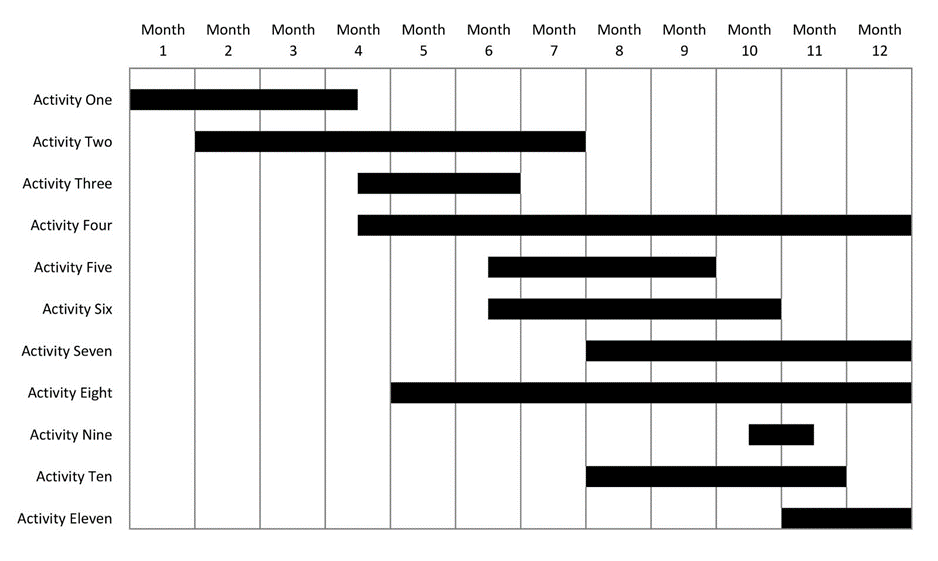
Find detailed instructions to
help you complete an IMLS Budget Form and write a Budget
Justification:
IMLS Budget Form
D
ownload
and complete the current IMLS
Budget Form
(PDF,
1.6MB).
Budget Justification
Write a Budget Justification to identify how each expense support your proposed activities, detail how you calculated all costs, and provide supporting documentation including any dollar amount that you may have consolidated and summarized on the IMLS Budget Form. We recommend that your Budget Justification have a section for each heading on the IMLS Budget Form. Save this document as a PDF.
Resumes of Key Project Staff and Consultants
Provide a resume for each person whose expertise is essential to the success of the project. We recommend limiting each resume to two pages. Save all the resumes in a single PDF. You must include the resume of the Project Director listed in Item 7 of the SF-424S. For research proposals, Project Directors are encouraged to include their Persistent Identifier (e.g. ORCID) near the top of their Resume.
If you cannot identify key project staff by the application deadline, then instead of a resume, provide position description(s) including the qualities, range of experience, and education necessary to successfully implement and complete project activities.
Digital Products Plan
We define digital products very broadly to include digital content (including but not limited to: software, PowerPoints, datasets, websites, white papers, and curricula). In your Digital Products Plan, address each of the following for each type of major digital output you will create during your project. We recommend limiting your plan to two pages. Save the document as a PDF.
 Type:
What types of digital products will you create?
Type:
What types of digital products will you create?
Availability: How will you make your digital products openly available (as appropriate)?
Access: What rights will you assert over your digital products, and what limitations, if any, will you place on their use? Will your products implicate privacy concerns or cultural sensitivities, and if so, how will you address them?
Sustainability: How will you ensure the sustainability of your digital products?
Performance Measurement Plan
Your Performance Measurement Plan should show how you will monitor and assess your performance as an awardee and achieve your selected program objective from the perspectives of Effectiveness, Efficiency, Quality, and Timeliness for your overall project.
For each performance measure, identify what data you will collect from what source, the method you will use to collect it, and according to what schedule. The chart below provides sample statements for each measure and a space to record your own. We've provided a fillable version of this chart (DOCX, 25KB), which you’re welcome, but not required, to use. We recommend limiting your Performance Measurement Plan to two pages. Save your document as a PDF.

Conditionally Required Documents
These documents may be required for your application, depending on the circumstances. Refer to the table below to determine which, if any, Conditionally Required Documents you may need to provide.
If you fail to provide a Conditionally Required Document, we will consider your application to be incomplete, and we may reject it from further consideration.
If you are: |
Then you must provide: |
Notes: |
Applying as a private, nonprofit institution (as indicated by choosing “M” or “X” as the Applicant Type code in 5d of the SF-424S form). |
A copy of the IRS letter indicating your eligibility for nonprofit status under the applicable provision of the Internal Revenue Code of 1954, as amended. |
You must submit this letter with each application even if you have submitted it with other applications in the current year or in previous years. We will not accept a letter of State sales tax exemption as proof of nonprofit status. |
Applying as a nonprofit FOUNDATION (as indicated by…if needed?). |
A letter indicating that your foundation supports the specific library or archives, has the ability to administer the project, and can ensure compliance with the terms of this NOFO and the applicable law, including the IMLS Assurances and Certifications. |
You must submit this letter with each application even if you have submitted it with other applications in the current year or in previous years. |
Using a Federally negotiated indirect cost rate in your budget. |
A copy of your current Final Federally Negotiated Indirect Cost Rate Agreement. |
If you do not have a current negotiated (including provisional) indirect cost rate and elect to charge a de minimis rate of 15 percent of Modified Total Direct Costs (see 2 C.F.R. 200.414(f)), you do not need to provide any documentation. |
Submitting an Applied Research project proposal. |
A Public Access Plan for Research Projects (two pages, recommended) Explain how you will manage, share, preserve, document, and enable reuse of the research data and accompanying documentation you will create during the project. |
Refer to our guidance for creating a Public Access Plan for Research Projects . |
(Back to Table of Application Components)
Supporting Documents
You may submit a reasonable number of optional Supporting Documents that supplement the Narrative in support of the project description. Optional Supporting Documents should help IMLS staff and reviewers envision the project in greater detail, but they should not be used to introduce new topics nor to continue answers to the Narrative questions. Give each document a clear, descriptive title at the top of the first page. You may wish to consider the following:
Bibliography or references relevant to your proposed project design or evaluation strategy
Letters of participation from partners, consultants, or others who will work closely with you on your project (avoid solely boiler-plate commitment letters)
Letters of support from experts, stakeholders, or potential beneficiaries
Brief explanation of the applicant institution’s history, mission, governance structure, and community served
Reports from planning activities
Contractor quotes
Equipment specifications
Needs assessments or asset maps developed specifically for this project or community
Example survey or interview questions
(Back to Table of Application Components)
Application Checklist
Use this checklist to make sure you have everything you need to submit a complete application.
General Readiness |
|
Forms (follow form and Grants.gov instructions) |
Files Formatting Instructions |
|
Disclosure of Information in Applications
We may share grant applications, products, and reports to further the mission of the agency and the development of museum, library, archival, and information services. As a general practice, and except for information that is privacy-protected, information contained in IMLS applications that receive funding may be made public. Please identify any information you deem confidential and/or proprietary and seek to have protected.
Submission Requirements
and Deadlines
Submission Instructions
You must submit your applications for funding using Grants.gov Workspace. Do not submit through email or postal mail to IMLS.
Review the Registration Requirements and time frames. We strongly recommend that you obtain a UEI number, register with SAM.gov and Grants.gov, and complete and submit your application early. Leave plenty of time and use the contact information below to reach out to IMLS, the Federal Service Desk, or Grants.gov Help for questions and technical difficulties.
Programmatic, Administrative and Technical Support Contacts
IMLS
IMLS staff are available by phone and email to answer programmatic and administrative questions relating to this grant program. We also host webinars to introduce potential applicants to funding opportunities. For more information, see our list of webinars and instructions for accessing them.
Federal Service Desk
Visit the Federal Service Desk or call 1-866-606-8220 for questions about registering or renewing your registration with login.gov or SAM.gov. Hours of operation are Monday through Friday, 8 a.m. to 8 p.m. Eastern Time.
Grants.gov
Visit Grants.gov Support, email support@grants.gov, or call Grants.gov Applicant Support at 1-800-518-4726 for assistance with software issues, registration issues, and technical problems. Grants.gov Applicant Support is available 24 hours a day, seven days a week, except for federal holidays.
Be sure to obtain a case number when calling the Federal Service Desk or Grants.gov for support.
Submission Dates and Times
You must submit your applications for funding using Grants.gov Workspace. Do not submit through email or postal mail to IMLS.
For the NLG-L Program, Grants.gov will accept applications through 11:59 p.m. U.S. Eastern Time on March 13, 2026.
Grants.gov will create a date and time record when it receives the application. IMLS uses this timestamp to verify on-time application submission. The system will also generate a series of emails confirming the status of each application. Applicants can check the status of their application(s) in Grants.gov by using “Track My Application.” For further details, visit Check Application Status at Grants.gov.
We will not consider late application for funding. We award grants only to eligible applicants that submit complete applications, including attachments on or before the deadline.
Emergency Extensions
Under certain circumstances, we allow an extension of grant application deadlines for adversely affected applicant organizations located in counties listed in Emergency Declarations and/or Major Disaster Declarations. See Application Deadlines for further information.
Intergovernmental Review
This funding opportunity is not subject to intergovernmental review per Exec. Order No. 12372.

Learn About Application Review
In this step:
6. Application Review Information 47
Eligibility and Completeness Checks 47
Review and Selection Process 47
7. Award Notices 53
Application Review Information
Eligibility and Completeness Checks
We assess every application to make sure it meets basic requirements for eligibility and completeness.
We won’t consider an application that:
does not meet the eligibility criteria for the program
is submitted after the deadline
requests funding outside of the applicable range
does not adhere to the program’s funding restrictions and guidelines. and/or
is missing required or conditionally required application components.
If your application is rejected during these initial eligibility and completeness checks, we’ll notify you by email. If you believe we rejected your application in error, you can appeal the decision via email within ten business days of the date we sent the rejection notice.
Review and Selection Process
We use a peer review process to evaluate all complete applications from eligible institutions. Reviewers are professionals in the field with relevant knowledge and expertise in the types of project activities identified in the applications.
 We
instruct reviewers to evaluate applications according to the peer
review criteria detailed in the next section. Peer reviewers must
comply with IMLS Federal ethics and conflicts of interest
requirements.
We
instruct reviewers to evaluate applications according to the peer
review criteria detailed in the next section. Peer reviewers must
comply with IMLS Federal ethics and conflicts of interest
requirements.
The Director considers the input from the review process and makes final funding decisions consistent with the purposes of the agency’s mission and programs.
Peer Review Criteria
We instruct reviewers to evaluate applications according to the review criteria listed in this section and to consider all Required, Conditionally Required, and Supporting Documents..
Cost share is an eligibility criterion and is not considered in the review of applications. Learn more about cost share requirements for the NLG-L program.
Peer Review Criteria
We instruct reviewers to evaluate applications according to the review criteria listed in this section and to consider all Required, Conditionally Required, and Supporting Documents.
Cost share is an eligibility criterion and is not considered in the review of applications. Learn more about cost share requirements for this program.
Review Criteria |
|
Project Justification
|
|
P
|
For Applied Research projects:
|
Project Results
|
|
Risk Assessment
For awards with a total amount of Federal share greater than the simplified acquisition threshold, we’re required to review and consider applicant information in the designated integrity and performance system.
Learn more about the laws and regulations related to suspension and
debarment systems, the simplified acquisition threshold, and
applicant risk review:
 his
information is accessible through SAM. The simplified acquisition
threshold is currently $350,000 but is periodically adjusted.
his
information is accessible through SAM. The simplified acquisition
threshold is currently $350,000 but is periodically adjusted.
You may review information in the designated integrity and performance systems accessible through SAM and comment on any information about your organization that a federal awarding agency previously entered.
We will consider any comments by the applicant, in addition to the other information in the designated integrity and performance system, in considering the applicant’s integrity, business ethics, and record of performance under federal awards when completing the review of risk posed by applicants.
Award Notices
We will not release information about the status of an application until we have completed the peer review process and all deliberations.
We expect to notify successful and unsuccessful applicants of final funding decisions by email in August 2026.
Funded Applicants
If your application is funded, we’ll send your Authorizing Official, Project Director, and Grant Administrator an email notification with our congratulations and instructions for accessing our electronic grants management system, eGMS Reach. Once you activate your eGMS Reach account, you’ll have access to your Official Award Notification, award letter, reporting schedule, and IMLS-approved budget document, and anonymized reviewer feedback from your application’s peer review.
T
he
Official Award Notification is the only document obligating funds and
authorizing you to begin performance on its specified dates. Unless
you’ve confirmed and received prior written approval from us
that pre-award costs are allowed, incurring those costs before the
period of performance is at your own risk.
Unfunded Applicants
If your application is not funded, we’ll send your Authorizing Official, Project Director, and Grant Administrator an email notification to let you know that your application isn’t being funded. We’ll share the number of applications and the total of requested funding we received for the program this year. We’ll also provide anonymized reviewer comments and scores to help you understand the decision and help you decide whether to revise the proposal and submit it again to IMLS or another funding agency in the future.
.

Find Post-Award Information
In this step:
8. Post-Award Requirements and Administration 55
Post-Award Requirements and Administration
Administrative and National Policy Requirements
There are important laws and regulations you’ll need to understand and comply with if you receive an award. Awardees are subject to:
2 C.F.R. part 200 Uniform Administrative Requirements, Cost Principles, and Audit Requirements for Federal Awards, 2 C.F.R. part 3187;
The IMLS General Terms and Conditions for IMLS Discretionary Grant and Cooperative Agreement Awards (PDF, 460KB); and
Applicants for Federal funds must certify that they are responsible for complying with certain nondiscrimination, debarment and suspension, drug-free workplace, and lobbying laws. These are set out in more detail, along with other requirements, in the IMLS Assurances and Certifications. By submitting the application, which includes these Assurances and Certifications, you certify that you are in compliance with these requirements and that you will maintain records and submit any reports that are necessary to ensure compliance. Failure to comply with these statutory and regulatory requirements may result in the suspension or termination of an award and require that the awardee return funds to the government.
For information about award termination, please see the IMLS General Terms and Conditions for IMLS Discretionary Grant and Cooperative Agreement Awards and 2 C.F.R. § 200.340.
With certain IMLS-specific additions, IMLS regulations at 2 C.F.R. part 3187 have formally adopted the Uniform Guidance.
Reporting
Awardees must comply with the following reporting requirements.
Interim and final financial and performance reports are due according to the reporting schedule in your official award documents. You must submit your performance and financial reports in eGMS Reach. We may publish interim and final performance report content on the IMLS website.
You must also comply with 2 C.F.R. §§ 180 and 2 C.F.R. part 3185 with respect to providing information regarding all debarment, suspension, and related offenses, as applicable.
 If
the total value of your active grants, cooperative agreements, and
procurement contracts from all Federal agencies exceeds $10,000,000
for any period of time during the period of performance of this
Federal award,, you should refer
to the reporting requirements reflected in 2 C.F.R. part 200,
Appendix XII – Award Term and Condition for Recipient Integrity
and Performance Matters
(see
also 2 C.F.R. §§ 200.113 (Mandatory disclosures)
and 2
C.F.R. §§ 200.211(c)(1)(iii) (Information contained in a
federal award).)
If
the total value of your active grants, cooperative agreements, and
procurement contracts from all Federal agencies exceeds $10,000,000
for any period of time during the period of performance of this
Federal award,, you should refer
to the reporting requirements reflected in 2 C.F.R. part 200,
Appendix XII – Award Term and Condition for Recipient Integrity
and Performance Matters
(see
also 2 C.F.R. §§ 200.113 (Mandatory disclosures)
and 2
C.F.R. §§ 200.211(c)(1)(iii) (Information contained in a
federal award).)

Other Information
In this section:
9. Other Important Information 58
Conflict of Interest Requirements 58
Additional Information about IMLS 59
IMLS Obligations to Make Awards 59
Other Important Information
Acknowledging IMLS Support
Awardees must include acknowledgement of IMLS support in all grant products, publications, websites, and presentations developed with IMLS funding.
All work products should reference IMLS and include the associated award number(s). Our Grantee Communications Kit provides guidance for fulfilling these requirements.
Conflict of Interest Requirements
Awardees must follow IMLS conflict of interest policies for federal awards. You must disclose in writing any potential conflict of interest to an IMLS Program Officer, or to the pass-through entity if you are a subrecipient or contractor. This disclosure must take place immediately whether you are an applicant or have an active IMLS award.
The IMLS conflict of interest policies apply to subawards as well as contracts, and are as follows:
You must maintain written standards of conduct covering conflicts of interest and governing the performance of your employees engaged in the selection, award, and administration of subawards and contracts.
None of your employees may participate in the selection, award, or administration of a subaward or contract supported by a federal award if he or she has a real or apparent conflict of interest. Such a conflict of interest would arise when the employee, officer, agent, board member, or any member of his or her immediate family, his or her partner, or an organization which employs or is about to employ any of the parties indicated herein, has a financial or other interest in or a tangible personal benefit from an organization considered for a subaward or contract. The officers, employees, agents, and board members of your organization must neither solicit nor accept gratuities, favors, or anything of monetary value from subrecipients or contractors or parties to subawards or contracts.
If you have a parent, affiliate, or subsidiary organization that is not a state, local government, or Indian tribe, you must also maintain written standards of conduct covering organizational conflicts of interest. Organizational conflicts of interest means that because of relationships with a parent company, affiliate, or subsidiary organization, you are unable or appear to be unable to be impartial in conducting a subaward or procurement action involving a related organization.
Additional Information about IMLS
Visit the IMLS website for additional information on IMLS and IMLS activities.
IMLS Obligations to Make Awards
This announcement does not obligate IMLS to make any federal award or commitment.
Peer Review
Any individual who is interested in serving as a peer reviewer is welcome to enter their contact information and identify their experience and expertise through the IMLS online reviewer application portal. IMLS staff will notify the individuals who are identified as potential reviewers by email prior to the next review period to confirm availability.
Copyright Information
Awardees may copyright any work that is subject to copyright and was developed under an award or for which ownership was acquired under a federal award. IMLS reserves a royalty-free, nonexclusive, and irrevocable right to reproduce, publish, or otherwise use the work for federal purposes and to authorize others to do so. For additional information, please see 2 C.F.R. § 200.315 (Intangible property).
Application Completion Time
Complete applications include the elements listed in the Table of Application Components. We estimate the average amount of time needed for one applicant to complete the narrative portion to be 45 hours. This includes the time for reviewing instructions, searching existing data sources, gathering and maintaining the data needed, and writing and reviewing the answers.
We estimate that it will take an average of 30 minutes per response for the IMLS Library Discretionary Program Information Form and three hours per response for the IMLS Budget Form.
We welcome your suggestions for improving this collection of information and for making it as easy to use as possible. Send comments regarding this burden estimate or any other aspect of this collection of information, including suggestions for reducing this burden, to our Office of Grants Management. Please note that applicants are not required to respond to any collection of information unless it displays a currently valid Office of Management and Budget (OMB) control number.
PRA Clearance Number
OMB Control No.: 3137-0091, Expiration date: 7/31/2027

Additional Guidance
In this section:
Guidance for Required Registrations 62
Getting a Unique Entity Identifier 62
Registering with Grants.gov 63
Guidance for Completing Forms and Other Application Components 64
IMLS Library – Discretionary Program Information Form (PIF) 68
Indirect Costs in the Budget 73
Student Support Costs in the Budget 75
Guidance for Required Registrations
Getting a Unique Entity Identifier
The Unique Entity Identifier (UEI) number is a non-proprietary alphanumeric identifier assigned to all entities (public and private companies, individuals, institutions, or organizations) who register to do business with the Federal Government. The UEI is requested in, and assigned by, the System for Award Management (SAM). Awardees must inform any subrecipients that the awardee may not make a subaward unless the subrecipient has also obtained a UEI.
If your organization has an active SAM registration, you can find your assigned UEI in your SAM record. The organization’s UEI must be active at the time of application and award. If you don’t yet have an active SAM registration, you will receive a UEI when you register in SAM.
Registering with SAM
The System for Award Management (SAM) is a federal repository that centralizes information about grant applicants and awardees. It is always free to all users. You must register with SAM before registering with Grants.gov. Learn how to check an organization’s registration status in SAM.
If you’re registering with SAM for the first time, you must begin by creating a SAM user account through Login.gov. Click here to learn how to create a secure Login.gov account. Then proceed to the SAM registration process.
We recommend that you allow several weeks to complete the SAM registration.
You must always maintain an active SAM registration with current information while you have an active award or an application under consideration. We may not make an award to you until you have complied with all applicable Unique Entity Identifier and SAM registration requirements. If you have not fully complied with the requirements by the time we’re ready to make a federal award, we may make a Federal award to another applicant.
You must renew your organization’s registration in SAM at least every 12 months or whenever your organization’s information changes. An expired registration will prevent you from submitting applications via Grants.gov and receiving awards or payments. Award payments will be made to the bank account that is associated with your organization’s SAM registration.
Registering with Grants.gov
Grants.gov is the centralized website for grant seekers to find and apply for federal funding opportunities. Grants.gov is owned and operated by the Federal Government and is always free to all users.
You must register with Grants.gov prior to applying. The multistep registration process cannot be completed in a single day. You should make sure your institution’s SAM registration is current and active before registering with Grants.gov. If your organization is not already registered, allow several weeks before the application deadline to complete this one-time process. Do not wait until the day of the application deadline to register.
The Grants.gov user ID and password you obtain when you register are required to submit your application.
After your organization registers with Grants.gov and creates an Organizational Applicant Profile, the request for the organization’s Grants.gov roles and access is sent to the eBiz POC. The eBiz POC will then log into Grants.gov and assign the appropriate roles to individuals within the organization. This will include the Authorized Organization Representative (AOR) which will give permission to complete and submit applications on behalf of the organization.
T IP:
Designating more than one Authorized Organization Representative
(AOR) when you register in Grants.gov will help avoid last-minute
crises if a single AOR is unavailable when you are ready to submit
the application. It is also important to update the contact
information and password in Grants.gov whenever an AOR changes.
IP:
Designating more than one Authorized Organization Representative
(AOR) when you register in Grants.gov will help avoid last-minute
crises if a single AOR is unavailable when you are ready to submit
the application. It is also important to update the contact
information and password in Grants.gov whenever an AOR changes.
Visit Grants.gov/Support, email support@grants.gov, or call Grants.gov Applicant Support at 1-800-518-4726 for technical assistance. Grants.gov Applicant Support is available 24 hours a day, seven days a week, except for federal holidays.
Guidance for Completing Forms and Other Application Components
Grants.gov Forms
SF-424S Form
The SF-424S Form, or the Application for Federal Domestic Assistance/Short Organizational Form, is part of the application package in Grants.gov.
SF-424S Item |
Instructions |
Items 1 - 4 |
Grants.gov automatically populates items 1-4. |
Item 5. Applicant Information |
Use the following format: two-letter state abbreviation, followed by a hyphen, followed by a zero, followed by the two-digit district number. For example, if the organization is located in the 5th Congressional District of California, enter “CA-005.” For the 12th Congressional District of North Carolina, enter “NC-012.” For states and territories with “At Large” Congressional Districts—that is, one representative or delegate represents the entire state or territory—use “001,” e.g., “VT-001.If your organization does not have a congressional district (e.g., it is located in a U.S. territory that does not have districts), enter “00-000.” To determine your organization’s district, visit the House of Representatives website and use the “Find Your Representative” tool. |
Item 6. Project Information
|
NOTE: We use Login.gov for user authentication in our electronic grants management system, eGMS Reach. Login.gov helps protect user identity through stronger passwords and two-factor authentication. e |
Item 7. Project Director
|
The Project Director will have primary responsibility for carrying out your project’s activities. Enter the requested information for this individual here. We require that the Project Director be a different person than the Authorized Representative. |
Item 8. Primary Contact/Grants Administrator
|
The Primary Contact/Grants Administrator has the core responsibility for administering the award. Enter the requested information for this individual here. Please still complete both items 8 and 9 if the Primary Contact/Grants Administrator is the same as the Authorized Representative. In some organizations this individual may be the same as the Project Director. If this is the case, check the box and skip to Item 9. |
Item 9. Authorized Representative
|
The Authorized Representative has the authority to legally bind your organization. Enter the requested information for this individual here. The Authorized Representative cannot be the same person as the Project Director. By checking the “I Agree” box at the top of Item 9, this individual certifies the applicant’s compliance with the IMLS Assurances and Certifications and any other relevant federal requirements. Grants.gov automatically populates the “Signature of Authorized Representative” and “Date Signed” boxes upon submission of the application. This is the person whose name was listed as your organization’s authorized representative when you registered with Grants.gov. Please note that this name might not be the same as the name and other information you entered in Item 9 above. |
By submitting the electronic application, you acknowledge that your organization certifies compliance with relevant federal requirements, including but not limited to the IMLS Assurances and Certifications, to the same extent as a signature does on a paper application.
IMLS Library – Discretionary Program Information Form (PIF)
Make sure that JavaScript is enabled in your web browser. Download the IMLS Library – Discretionary Program Information Form (PDF, XXX MB) to your computer and work on it outside your web browser. When you’ve completed the form, save it as a PDF and upload it as part of your application through Grants.gov.
PIF Section |
Instructions |
Section 1. Grant Program |
Select National Leadership Grants for Libraries Program. Then select one project type. Refer to Project Types for more information and to help you select the right project type for your application. |
Grant Program Goals and Objectives |
Refer to the NLG-L Program Goal and Objectives. Select the NLG-L objective that best aligns with your proposed project. |
Section 2. Applicant Information |
Does this entity have an organizational unit that will carry out the activities described in your application? Refer to the entity listed in Item 5a of the Grants.gov SF-424S Form that you are submitting with your application and review the Helpful Definitions of organizational unit and legal applicant on the Program Information Form. Then select YES if your organization has an organizational unit and NO if it does not. Next, make selections from the choices and provide the information requested. |
Section 3. Financial Information |
Provide the information requested in items a-d. If you named an organizational unit in Section 1 of this form, this information must pertain to that unit. Please complete the table with figures representing the most recently completed fiscal year in the top row, followed by those for the previous year, and concluding with those for the year before that. |
Section 4. Funding Request |
Refer to the Grant Fund and Cost Share totals in Section 10 of the IMLS Budget Form (PDF, 1.6MB) that you are submitting with your application. Provide the amount in dollars that you are requesting from IMLS and the amount of non-federal funding you are providing as cost share/match. Enter “0” if your budget includes no cost share/match. |
Section 5. Indirect Costs |
Refer to the IMLS Budget Form – Indirect Costs in the Budget guidance. Select one option and provide any required information for your selection. Your selection should match the choice you make on your IMLS Budget Form. |
Section 6. Abstract |
Write an Abstract of no more than 3,000 characters (including spaces) in a concise narrative format for experts as well as a general audience. Address the following:
Enter or paste your text into the form.
|
IMLS Budget Form
Make sure that JavaScript is enabled in your web browser. Download the IMLS Budget Form (PDF, 1.6MB) to your computer and work on it outside your web browser. When you’ve completed the form, save it as a PDF and upload it as part of your application through Grants.gov.
The IMLS Budget Form accommodates up to three years of project activities and expenses. Project timelines, allowable costs, and other budget details vary by program. Be sure to review the Notice of Funding Opportunity for the grant program/project type to which you are applying and the cost principles in 2 C.F.R. part 200 and 2 C.F.R. part 3187.
The Year 1 columns should include costs for activities that begin on the project start date (as listed on 6c of the SF-424S) and end 12 months later. If the project timeline exceeds one year, list the costs for the next 12 months in the Year 2 columns. If the project extends beyond two years, list the costs for the next 12 months in the Year 3 columns.

T
ips
for completing your budget form:
The budget should include the project costs that will be charged to grant funds as well as those that will be supported by cost share, if any.
In-kind contributions to cost share may include the value of services (e.g., donated volunteer or consultant time) or equipment donated to the project between the authorized start and end dates of your project.
All the items listed, whether supported by grant funds or cost share, must be necessary to accomplish project objectives, allowable according to the applicable federal cost principles, auditable, and incurred during the award period of performance.
Charges to the project for items such as salaries, fringe benefits, travel, and contractual services must conform to the written policies and established practices of your organization.
You must report all revenues generated with project funds during the award period of performance as program income.
If you need more lines for a specific section, summarize the information in the IMLS Budget Form and explain it further in the Budget Justification.
Budget Form Section |
Instructions |
|
Include both temporary and permanent staff as well as volunteers engaged in project activities. Document how you calculated salaries and wages in your Budget Justification by including the base salary or wages for each person and the percentage of time each person is allocated to the project activities, which may be shown as a percentage of time, number or days, or number of hours. |
|
Fringe benefits can be claimed as a direct cost for only those positions included in your direct cost pool and only on the portion of salaries and wages identified for this project. Indicate your organization’s fringe benefit rate (in percent) and the base (in dollars) to which the rate is applied (e.g., 20% x $175,089.00). |
|
Explain how you calculated each travel cost, including subsistence, lodging, and transportation, in your Budget Justification. You must use the lowest available commercial fares for coach or equivalent accommodations, and you must use U.S. flagged air carriers for foreign travel when such services are available, in accordance with applicable U.S. legal requirements. |
|
List the costs of supplies, materials, and equipment purchased specifically for the proposed project. For definitions and other information, please see 2 C.F.R. part 200. Use the Budget Justification to explain or describe these items in further detail. |
|
List each third party that will undertake project activities and their associated costs as an individual line item on your IMLS Budget Form. Designate each third party as either a subaward or a contract using the dropdown menu on each line. Itemize these third-party costs in your Budget Justification. |
|
If your project includes Student Support costs, enter them in this section. Refer to Student Support Costs in the Budget for a definition and examples. |
|
Use this section for costs that cannot be assigned to other categories. Do not use this section to list items that do not fit in the lines allotted for another section. |
|
These amounts will total automatically. |
|
Indirect costs are expenses that are incurred for common or joint objectives that cannot be easily identified with a particular project. Indicate your organization’s indirect cost rate (in percent) and the base (in dollars) to which the rate is applied (e.g., 34% x $123,456.78). Refer to Indirect Costs in the Budget for more information. |
|
These amounts will total and round up to the nearest dollar automatically. |
Cost Share in the Budget
Cost share is the portion of the project costs that is not paid by IMLS funds. Common examples of cost share include cash outlays; contribution of property and services; and in-kind contributions, such as staff or volunteer time that support project activities.
In this grant program, National Implementation project proposals requesting more than $299,999 must include at least a 1:1 cost share from non-federal sources.
All expenses, including cost share, must be incurred during the award period of performance unless otherwise specified and allowed by law. Federal funds from other federal awards may not be used for cost share. All federal, IMLS, and program requirements regarding the use of funds apply to both requested IMLS funds and to cost share. See 2 C.F.R. §§ 200.1 and 200.306 for more information on cost share.
Indirect Costs in the Budget
Indirect costs are expenses incurred for common or joint objectives and thus cannot be readily associated with a particular project. Some examples include depreciation on buildings and equipment, the costs of operating and maintaining facilities, and general administration and general expenses, such as the salaries and expenses of executive officers, personnel administration, and accounting. See 2 C.F.R. § 200.414 for additional guidance on indirect costs.
Options for Calculating and Including Indirect Costs in a Project Budget
You can choose to:
use a rate not to exceed your current indirect cost rate already negotiated with a federal agency;
use an indirect cost rate proposed to a federal agency for negotiation but not yet finalized, as long as it is finalized by the time of the award;
use a rate not to exceed 15 percent of Modified Total Direct Costs (MTDC) if the organization currently does not have a Federally Negotiated Indirect Cost Rate Agreement (NICRA) and is not subject to other requirements; or
not include any indirect costs.
Using a Federally Negotiated Indirect Cost Rate Agreement
A Federally Negotiated Indirect Cost Rate Agreement (NICRA) is a document that reflects an estimate of indirect costs negotiated between the Federal Government and a non-federal organization. There are several types of indirect cost rates (e.g., Provisional, Predetermined, Fixed, Final), and some agreements identify several locations to which a particular rate applies (e.g., on-site/campus, off-site/campus), and/or program types for which a particular rate may be used (e.g., Instruction, Organized Research, All Programs, Other Sponsored Activities).
If your organization already has a NICRA in effect, you may use one of the approved rates in the calculation of your project’s indirect costs and by extension, your total project costs, if you apply the appropriate rate and include a copy of the current agreement with your grant application. You may choose to use a rate lower than a rate in your agreement, but you may not choose a higher one. We will accept only those NICRAs that are current by the award date.
C
arefully
review your institution’s negotiated indirect cost rate(s) to
make sure you are using the appropriate rate for your project.
For the NLG-L Program, we will only accept the Research rate in your IMLS project budget if your selected Project Type is Applied Research. See Project Types for more information.
Please be aware that the indirect cost rate used in your approved IMLS budget (and that will also appear on the Official Award Notification if you receive an award) will apply throughout the life of your award. You may not use a different rate for the award, even if you negotiate a new rate with your cognizant agency after the award has begun.
Using a Proposed Indirect Cost Rate
If your organization is currently negotiating a NICRA with a federal agency, you may use the indirect cost rate proposed to the federal agency to estimate indirect and total project costs. In such situations, if we issue an award, we will accept the rate only if the negotiations are final by the award date and you submit a copy of the final agreement to us. IMLS staff will work with you to adjust your budget prior to issuing an award.
Using the 15 Percent De Minimis Indirect Cost Rate
You may choose to charge a de minimis rate of up to 15 percent of Modified Total Direct Costs (MTDC), as long as you do not have a current NICRA and you meet the applicable requirements. See 2 C.F.R. part 200, including 2 C.F.R. §§ 200.1 (Definitions), 200.414(f), and 200.510(b)(6) for additional guidance.
Modified Total Direct Costs include:
all direct salaries and wages,
applicable fringe benefits,
materials and supplies,
services,
travel, and
up to the first $50,000 of each subaward (regardless of the period of performance of the subawards under the award).
Modified Total Direct Costs exclude:
equipment,
capital expenditures, charges for patient care,
rental costs,
tuition remission,
scholarships and fellowships,
participant support costs, and
the portion of each subaward in excess of $50,000.
Other items may only be excluded when necessary to avoid a serious inequity in the distribution of indirect costs, and with the approval of the cognizant agency for indirect costs. See 2 C.F.R. § 200.1 for additional information.
If you are using the 15 percent de minimis indirect cost rate, check the box indicated on the IMLS Budget Form. No additional documentation is required.
Applying an Indirect Cost Rate to the Cost Share Portion of a Budget
You may, if consistent with 2 C.F.R. part 200 (Uniform Guidance), apply your indirect cost rate to your total direct costs covered by cost share, but you must account for any costs you claim as cost share in the cost share column on the IMLS Budget Form. IMLS funds can be used for indirect costs, but only for the portion of the total direct costs for which you are requesting IMLS funds (the Grant Funds column). (See, for example, 2 C.F.R. §§ 200.412-414.)
Restrictions on Project Costs Included in Indirect Cost Calculations
If you have a current NICRA, you must follow its conditions and requirements.
As noted above, if you do not have a current NICRA and meet applicable requirements, you may elect to charge a de minimis rate of up to 15 percent of the Modified Total Direct Costs (MTDC) in your indirect cost calculations.
If you have a current NICRA with a rate of less than 15 percent, you must use it rather than the de minimis rate in your indirect cost calculations.
Please see the section above on the 15 percent de minimis rate as well as 2 C.F.R. § 200.414(f) and § 200.1 Definitions.
Student Support Costs in the Budget
Students are:
Individuals enrolled in a middle school, high school, community college, undergraduate, or graduate program of study
Individuals participating in post-master’s or post-doctoral programs that are focused on supporting their careers or professional development
Library, archives, and museum staff participating in education and training activities focused on their careers or professional development.
Examples of Student Support include:
Tuition support for students participating in the project
Salaries or stipends for graduate assistant work, if their work is focused on research and teaching activities (therefore contributing to their education)
Pay and benefits for a resident or fellow to work in a position that is intended to support their learning outcomes or professional development
Costs for travel and conference registration provided to support a student or participant’s learning outcomes or professional development
Costs of supplies and equipment provided to students to support a student’s learning outcomes or professional development.
Activities not considered Student Support include:
Students employed in roles that are primarily administrative or clerical, doing work that is not primarily focused on their career or professional development. These costs should be listed in the Salaries and Wages section of the budget, and tuition paid on behalf of these students would not be considered Student Support.
See 2 C.F.R. § 200.466 (Scholarships and student aid costs); see also 2 C.F.R. § 200.430 (Compensation – personal services).
Budget Justification
To write your Budget Justification, follow the IMLS Budget Form’s section headings to organize the document and save it as a PDF. Address both grant funds and cost share, if included. Do not use your Budget Justification to expand your narrative.
Budget Section |
Instructions |
|
|
|
|
|
|
|
|
|
You are responsible for making a case-by-case determination as to whether the agreement you make with a third party should be a subaward or a contract. That determination will depend upon the nature of your relationship with the third party with respect to the activities to be carried out. See 2 C.F.R. § 200.331 (Subrecipient and contractor determinations). |
|
Explain your method for calculating the costs listed in this section. See the definition and examples of Student Support. |
|
Use this section for costs that cannot be assigned to other categories. |
|
Indicate the total direct costs and specify how much you are asking from IMLS and how much you intend to provide as cost share, if any. |
|
If you include indirect costs in your project budget, identify the indirect cost rate (in percent) and the base (in dollars) to which the rate is applied. Read about indirect costs in the Budget.. |
|
Indicate the total project costs here and specify how much you are asking from IMLS and how much you intend to provide as cost share, if any. |
Proof of Private, Nonprofit Status
An organization applying as a private, nonprofit institution must submit a copy of the letter from the Internal Revenue Service indicating its eligibility for nonprofit status under the applicable provision of the Internal Revenue Code of 1954, as amended. (See 2 C.F.R. § 3187.7(b).) IMLS will not accept a letter of state sales tax exemption as proof of nonprofit status.
Digital Products Plan
We are committed to expanding public access to digital products created using federal funds. We ask each applicant to create and submit a Digital Products Plan describing how you will address specific aspects of creating and managing digital products, employing practices and standards that are most appropriate for their specific project. IMLS staff and peer reviewers will assess your plan, and it will be important in determining whether your project will be funded. Organize your plan to address the following:
Type
Availability
Access
Sustainability.
We participate in the Federal Agencies Digital Guidelines Initiative (FADGI), a collaborative effort by federal agencies to define common standards, guidelines, methods, and best practices for creating digital collections. Visit the FADGI website for a growing list of links to relevant standards, recommendations, and other resources. While this list is not exhaustive—nor do we endorse any specific resource—applicants considering digital projects may find the information useful.
Use the guidance below to help you create and organize your Digital Products Plan.
T ype
ype
What digital products will you create?
Most projects are likely to generate digital content, resources, or assets. They may be digitized or born-digital products created by individuals, project teams, or through community gatherings. Examples include, but are not limited to, still images, audio files, moving images, microfilm, object inventories, object catalogs, artworks, books, posters, curricula, field books, maps, notebooks, scientific labels, metadata schema, charts, tables, drawings, workflows, teacher resources, and software, including source code, algorithms, applications, and digital tools, plus accompanying documentation.
In your Digital Products Plan,
describe the digital content, resources, or assets you will create or collect,
the quantities of each type,
the digital file format(s),
the accompanying metadata, and,
any relevant standards you will use.
If you are developing software, you should also specify the programming languages, platforms, frameworks, software, or other applications you will use to create your software and explain why you chose them.
A vailability
How will you make your digital products openly available (as appropriate)?
We encourage grant recipients to make works produced with IMLS support widely available, and to share their work products (including publications, datasets, educational resources, software, and digital content) whenever possible through free and open-access journals and repositories. Your project may involve making digital products available through public or access-controlled websites, kiosks, or live or recorded programs.
We expect you to ensure that publications produced under an award (including but not limited to peer-reviewed manuscripts resulting from research conducted under an award) are made available in a manner that permits the public to access, read, download, and analyze the work without charge.
In your Digital Products Plan,
describe how you will make the digital content, resources, assets, software, and metadata available to the public;
include details such as the delivery strategy (e.g., openly available online, available to specified audiences) and underlying hardware/software platforms and infrastructure (e.g., specific digital repository software or leased services, accessibility via standard web browsers, requirements for special software tools to use the content, delivery enabled by IIIF specifications); and
identify and explain the reasons for any limitations in your Digital Products Plan.
 Access
What rights will you assert over your digital products, and what limitations, if any, will you place on their use?
Will your products implicate privacy concerns or cultural sensitivities, and if so, how will you address them?
Award recipients may copyright any work that is subject to copyright and that was developed under an award or for which ownership was purchased. However, IMLS reserves, for Federal Government purposes, a royalty-free, nonexclusive, and irrevocable right to reproduce, publish, or otherwise use the work and authorize others to reproduce, publish, or otherwise use the work.
We expect applicants receiving federal funds for developing or creating digital products to release these files under open-source licenses to maximize access and promote reuse. All work products resulting from IMLS funding should be distributed for free or at cost unless IMLS has provided written approval for another arrangement.
In your Digital Products Plan,
identify any licenses under which digital products will be shared (e.g., Creative Commons licenses, RightsStatements.org statements);
describe what intellectual property rights you will assert over your digital products and explain any limitations or conditions you will place on their use, and;
if your products implicate privacy concerns or cultural sensitivities, describe these issues and how you plan to address them.
S ustainability
How will you address the sustainability of your digital products?
To the maximum extent possible, the digital products created with IMLS funding should be freely and readily available for use and reuse by libraries, archives, museums, and the public.
Some digital products that are generated during a project should be long-lived, requiring permanent preservation, and others (e.g., preliminary analyses, drafts of papers, plans for future work, peer-review assessments, most social media communications, and communications with colleagues) should be retained and shared in the medium- or short-term.
In your Digital Products Plan,
describe your plan for preserving and maintaining digital products during and after the period of performance;
identify the appropriate length of time different digital products should be curated;
address storage systems, shared repositories, technical documentation, migration planning, and commitment of organizational funding for these purposes.
Note: You may charge the federal award before closeout for the costs of publication or sharing of results if the costs are not incurred during the period of performance of the federal award (see 2 C.F.R. § 200.461).
Public Access Plan for Research Projects
The sharing of research findings, data, and other deliverables is an essential component of research and expedites the translation of research results into new knowledge and practices.
If you are preparing a research proposal, you will need to provide a Public Access Plan to describe how you will follow the IMLS Public Access Policy Guidance for:
public access to peer-reviewed scholarly publications, and
public access to permissible scientific research data underlying peer-reviewed scholarly publications.
The Public Access Plan guides research applicants through planning how they will provide public access throughout the course of the proposed research project. If awarded, the General Terms and Conditions further outline the public access expectations for awardees. Applicants are expected to read the full IMLS Public Access Policy Guidance page to learn more about the legal requirements and find definitions specific to Public Access prior to creating your plan.
In one to two pages, address the following bullet points as related to your proposed project:
Peer-reviewed Scholarly Publications Access:
Identify the type(s) and estimated amount of peer-reviewed scholarly publications you intend to publish.
Describe your plan to submit a machine-readable copy of the most-appropriate version of a published manuscript to IMLS no later than the article’s publication date. (See the IMLS Public Access Policy Guidance for definitions of key terms).
Permissible Scientific Research Data Management and Access:
Researchers must deposit permissible scientific research data underlying peer-reviewed scholarly publications into a chosen repository immediately following publication. Researchers may choose the most appropriate repository.
Identify the type(s) and estimated amount of data you plan to collect or generate.
Will you collect any sensitive information? This may include personally identifiable information (PII), confidential information, or proprietary information (e.g., trade secrets). If so, detail the specific steps you will take to protect the information while you prepare it for public release (e.g., anonymizing individual identifiers, data aggregation).
Awardees are expected to share as much data as possible. If some of the data will not be released publicly, explain why the data cannot be shared due to the protection of privacy, confidentiality, security, intellectual property, and other rights or requirements.
What technical (hardware and/or software) requirements or dependencies would be necessary for understanding, retrieving, displaying, processing, or otherwise reusing the data? How can these tools be accessed by the public?
What documentation (e.g., consent agreements, data documentation, codebooks, metadata, and analytical and procedural information) will you capture or create along with the data? Where will the documentation be stored and in what format(s)? How will you permanently associate and manage the documentation with the data it describes to enable future reuse?
Identify the repository where you will deposit your data and describe any additional plans for managing, disseminating, and preserving data after the completion of the award-funded project.
When and how frequently will you review this Public Access Plan to ensure compliance?

| File Type | application/vnd.openxmlformats-officedocument.wordprocessingml.document |
| File Title | Laura Bush 21st Century Librarian Program FY 2026 Notice of Funding Opportunity |
| Subject | Laura Bush 21st Century Librarian Program FY 2026 Notice of Funding Opportunity |
| Author | InstituteofMuseumandLibraryServices@imls.gov |
| File Modified | 0000-00-00 |
| File Created | 2025-12-10 |
© 2026 OMB.report | Privacy Policy